Urban collapse: what cities teach us when systems fail
In brief: Cities rarely collapse by emptying out. More often, the systems that make ordinary life possible become unreliable while most people stay where they are. Drawing on what I witnessed in Iraq after the fall of Saddam Hussein, Haiti after the 2010 earthquake and the Central African Republic during periods of armed insecurity — alongside wartime Sarajevo, post-Katrina New Orleans, crisis-stricken Beirut, declining Detroit and Havana during Cuba’s Special Period — this article looks at how people recreate movement, shelter, markets, security, information and governance when formal systems fail. Their improvisations can preserve life, but they also redistribute power. The question is not only how resilient our communities are, but what kind of order emerges when the old systems stop working, and what we can do now to shape it.
The first time I was shot at was in Baghdad, about an hour after I landed.
It was in April 2003, roughly three weeks after United States forces entered the Iraqi capital and Saddam Hussein’s government fell. I had just landed at Baghdad International Airport to begin working for a French humanitarian organisation. As we drove in, we turned into a street where a man was in the middle of carjacking another vehicle. He fired several rounds at us. We reversed hard and left.
I stayed in Iraq for nearly a year and a half. The carjacking was an abrupt introduction to the danger, but what stayed with me was not the incident so much as the absence it revealed. The Iraqi state had vanished, and many of the institutions that regulate daily life in the country had stopped functioning. No national police force was reliably keeping public order. International military forces were present and sporadically visible, but not doing the everyday security work residents expect of a police service. The regime had fallen, the police had largely disappeared, and much of the machinery that had administered urban life went with them.
Chaos quickly ushered, nowhere more clearly than on the roads.
Road rules stopped existing, all at once. Traffic lights and lanes became suggestions. People drove on whichever side they wanted, in whichever direction was quickest, ignoring signs and one another; if the sidewalk was faster, they drove on that too. There was something almost exuberant in it, a giddy taste of freedom after decades of dictatorship, as if the fall of an oppressive government meant every constraint it had imposed could be discarded at once.
It did not stay freedom for long, and quickly became paralysis. If everyone can drive wherever they please, soon no one moves at all. Intersections locked solid. Cars faced off from every direction, like the classic puzzle game Rush Hour.
But after a few weeks of increasing stalemates on every road, I watched people spontaneously get out of their vehicles, stand in the middle of the traffic jam, and start directing traffic, waving drivers back into lanes, ordering the one on the footpath down off it. Nobody had appointed them. They held no authority. They were simply rediscovering, in real time, that some rules are not just instruments of control but also agreements that let millions of strangers share a city.
That image made a strong impression on me, and stayed with me ever since: a society released from a brutal order, brought within days to a standstill, then beginning to rebuild coordination from below.
It also raises a question that reaches well beyond post-invasion Baghdad. What happens when the systems that make collective life possible stop working? What replaces them, who decides, and what can places that have not collapsed learn from those that have?
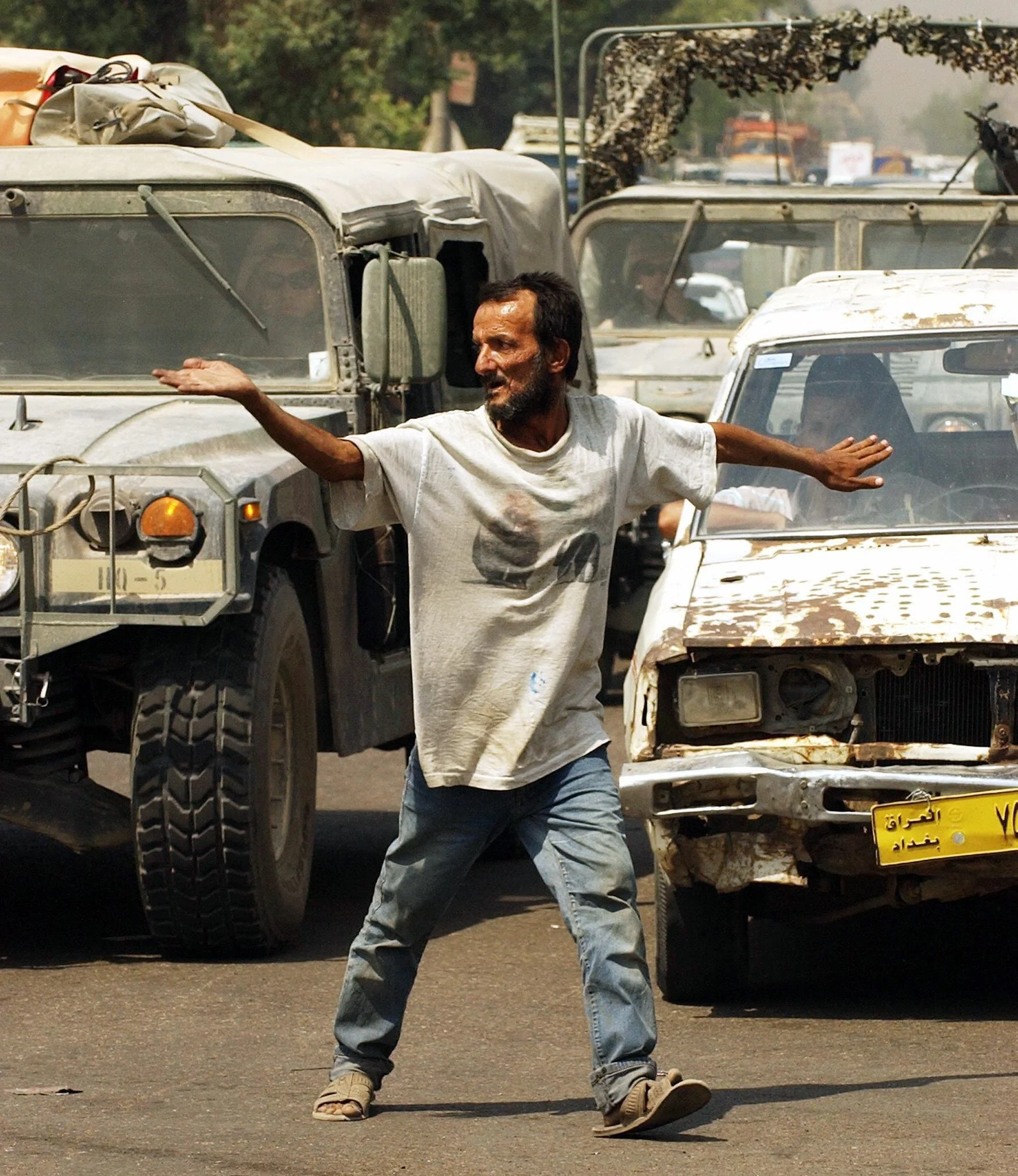
(Picture by Stan Honda/AFP via Getty Images)
What urban collapse actually means
In two earlier articles — Prepper or community builder? and What security actually is — I explored the difference between preparing to survive apart from other people and building the capacity to endure disruption together, and asked what real security requires once physical protection alone is not enough. I argued that capable households matter, but that their deeper value lies in what they can offer the people around them; and that security begins with relationships, awareness, information and options long before it reaches the point of physical defence.
This article takes those arguments to a larger scale. What happens when it is not a household or a neighbourhood under pressure, but most of the systems sustaining an entire city?
The word collapse needs care. It conjures ruins, chaos, a sudden descent into barbarism, and is used so loosely that it usually obscures more than it reveals. Cities rarely collapse by disappearing. People do not vanish when the power fails, a currency dies, government fragments or an earthquake flattens the housing stock. Most stay, because they have nowhere else to go, because family and livelihood are there, or because leaving has become too hard or too dangerous.
Urban collapse is better understood as the sustained degradation of the systems that normally make city life possible: government, electricity, water, sanitation, transport, housing, healthcare, education, markets, money, communications and security. They usually not all fail at once, or equally for everyone. One neighbourhood keeps its water while another loses it. Wealthier households buy generator power, imported medicine, private security. A hospital stands intact while lacking the staff, clean water, oxygen or fuel it needs to function.
The City Resilience Frameworkdistinguishes acute shocks — earthquakes, floods, conflict, major infrastructure failures — from chronic stresses such as inequality, ageing infrastructure, housing insecurity and unemployment. The distinction helps, though reality is messier. Baghdad’s breakdown in 2003 was acute, but it followed decades of dictatorship, war, sanctions and decaying infrastructure. Hurricane Katrina struck New Orleans in August 2005, yet the disaster exposed entrenched racial, economic and administrative inequalities. Sarajevo’s nearly four-year siege began in April 1992 as an acute military assault and became a prolonged condition of deprivation. Beirut’s crisis grew out of Lebanon’s financial collapse from 2019 and was then punctuated by the catastrophic port explosion of August 2020.
Shocks expose stresses. Unresolved shocks become chronic conditions. Chronic decline leaves a city less able to withstand the next shock.
The common thread is not that everything stops but that reliability disappears. People can no longer assume water will come from the tap, that an ambulance will arrive, that money in the bank can be withdrawn, that a traffic light will be obeyed, or that the institution responsible for a service still has the people, resources and legitimacy to provide it.
Urban life then reassembles through whatever remains: families, neighbours, faith communities, markets, criminal networks, aid organisations, local businesses, identity groups and improvised authorities. These arrangements can be humane and creative. They can also be exploitative, exclusionary or violent. Often they are both at once.
So the question is not whether order returns — some sort of ‘order’ almost always does. The harder question is what kind, who controls it, and whose needs it recognises.
Cities fail in different ways
Baghdad in 2003 showed one of the most visible forms of breakdown: the rapid disappearance of formal order. As the police and much of the state evaporated, people had to work out how to protect their homes and streets. Neighbourhood security arrangements formed, usually through existing relationships and often along religious, ethnic or communal lines. Shia communities protected Shia areas; Sunni networks organised their own; Kurdish, Christian and other groups relied on people they already knew and trusted.
This was resilience of a kind as people did not wait to be protected. But it also exposed the double edge of social cohesion. Strong ties within a group provide warning, help and safety while also hardening the boundary between that group and everyone else. The same bonds that make insiders safe can make outsiders suspect. Whether that heals a city or splinters it depends on whether people organise around something anyone can join, like a road, or around an identity that by definition shuts others out.
Space reorganised too. With homes destroyed and government buildings standing open, people moved into whatever could shelter them. I even visited families who went to occupy former gaols. The reversal was extraordinary: buildings made to confine people had become places people entered by choice, because the cells and walls kept out the weather. When the housing system fails, a building’s official purpose matters far less than whether it can keep someone alive.
The economy returned in fragments. At first, medicines, spare parts and repair materials were almost impossible to obtain; infrastructure could not be fixed because the parts, the people and the procurement systems were gone. Over time goods reappeared through revived trade, humanitarian supply chains, international funding and the vast reconstruction economy. Markets are remarkably adaptive that way — they often restore the flow of goods faster than governments restore services or legitimacy. But products back on shelves is not the same as recovery. A thing can be physically available and still be unaffordable, unreachable, or controlled by whoever holds the money, the connections or the guns.
New Orleans after Katrina reached a similar place by a different road. The hurricane and the failure of the city’s levees flooded vast areas. It did not topple the United States government obviously, but it overwhelmed the systems residents depended on, in a way eerily familiar to the residents of Lismore, NSW, who experienced multiple devastating floods in the past few years. Evacuation assumed a capacity to leave that was very unevenly distributed: of the roughly 100,000 people who remained in New Orleans, many had no car, and others were held back by age, disability, poverty, caring duties or simply having nowhere to go. The storm disrupted transport, communications, healthcare, power, water, sanitation and policing. Help came, but late, patchy and inadequate for many who needed it most. The lesson is not that assistance never arrives but that there is almost always a consequential interval between disruption and effective help, and much of what determines who survives, who is displaced and who recovers is decided in that gap.
The effects outlived the floodwater. Recovery decided who could return, which neighbourhoods drew investment, who could navigate insurance and rebuilding, and whether reconstruction restored communities or displaced them for good. A city can recover its tourism, its aggregate economy and its physical fabric without restoring the lives of the people who once filled it.
Sarajevo shows what happens when that interval stretches to years. Through the 1992–96 siege, Bosnian Serb forces surrounded the city and subjected it to constant shelling and sniper fire. Residents survived without reliable power, water, food, heating, transport or communications, crossing streets where an ordinary errand could be fatal. The Sarajevo Survival Guide, written during the siege, catalogues the improvised stoves, the water collection, the makeshift power, the cultivation and barter through which life went on. Reserves can carry a household through a short emergency; they cannot carry a city through years. What sustained the population in Sarajevo was relationships between households and apartment blocks, knowledge of where resources might be found, systems of exchange — and the stubborn continuation of school, music, theatre, humour and ordinary ritual. These were not luxuries indulged once survival was secured. They preserved the meaning, identity and morale people needed to keep going. A city is not alive merely because its inhabitants take in enough calories; it stays a city because people keep teaching, caring, arguing, creating and imagining a future.
Beirut and Detroit show that collapse can also arrive with no single decisive moment. Lebanon’s crisis since 2019 has hollowed out banking, currency, public services and trust. In Beirut, unreliable state electricity is patched by private diesel generators and, for those who can afford them, solar and batteries. Power became a layered commodity: a few hours from the grid, more bought from a neighbourhood generator operator, and real autonomy for households able to install their own — redundancy that also reproduced inequality, pollution and local monopolies.
Detroit declined over decades: deindustrialisation, segregation, suburban flight and population loss cut the city from about 1.85 million people in 1950 to under 640,000 by 2020, and in 2013 it entered the largest municipal bankruptcy in United States history. Infrastructure built for two million still had to be run by a fraction of them. The danger of slow decline is that it can be absorbed into ordinary life: a service that took minutes takes hours, a facility closes, a streetlight is never replaced, with each loss adapted to separately, until the cumulative failure is mistaken for the natural condition of the place. Yet Detroit also produced community organisations, urban farms and repair initiatives, and recent years have brought signs of stabilisation.
Havana offers a different ending. When the Soviet Union collapsed in 1991, Cuba abruptly lost much of the fuel, fertiliser, machinery and subsidised trade its economy ran on. A Special Period was announced and brought real hunger, blackouts and hardship; it was neither graceful nor painless. What makes it important is that some local improvisations were eventually recognised, supported and scaled. Vacant land was cultivated; urban and peri-urban agriculture expanded; food distribution and transport adapted. Policy, land access, technical knowledge and institutional backing turned scattered responses into a genuine urban food system. Local ingenuity rarely transforms a city on its own. It becomes systemic when institutions can see what is working, clear the obstacles and spread the benefit.
Together these places show that collapse is not one condition. It arrives by invasion, siege, flood, financial implosion, industrial decline or the sudden loss of energy and trade. Beneath the differences, the same urban functions keep surfacing, precisely because they can no longer be taken for granted.
The city is a system of systems
It is easy to mistake a city for its physical form — buildings, roads, bridges, pipes and rails — when it is really a dense weave of relationships among those assets and the institutions, workers, information, money and rules that animate them. The International Committee of the Red Cross, in its work on urban services in protracted conflict, makes the point sharply: water, power and sanitation are not just hardware waiting to be repaired. They depend on technicians, spare parts, fuel, procurement, records, access and coordination, and they degrade not only through destruction but through the slow loss of maintenance, expertise and supply chains. Infrastructure matters, as the World Bank puts it, because of the services it delivers to people: a road connects food, workers and patients; a power grid carries everything downstream of it. Collapse is rarely the failure of one thing, rather a cascade through their connections.
The practical implication is that resilience cannot be built by strengthening each system in isolation. It requires understanding the dependencies between them, identifying where one failure could disable several others, and ensuring that people can continue accessing essential services even when the primary system breaks down.
The relevant question is not simply whether a city has a hospital, water network, power grid or emergency plan. It is whether those systems can still operate when staff cannot travel, communications fail, fuel deliveries stop, digital payments are unavailable or the institution responsible for coordination has lost public trust.
This changes what preparedness looks like. It moves attention away from individual assets and towards the relationships that allow them to function: who operates them, what they depend upon, how they are maintained, what alternatives exist and who will be excluded when capacity becomes scarce.
Governance and the reconstruction of rules
The roads of post-invasion Baghdad were a small, sharp lesson in what governance actually does. Government and governance are not the same thing. Government is the formal institutions; governance is the wider process through which collective decisions get made, rules set, resources allocated and behaviour coordinated. When government disappears, governance does not vanish with it — it fragments. At a blocked Baghdad intersection, governance was whoever stepped out of a car and got others to follow a common direction. In a neighbourhood it might be a respected elder, a cleric, an armed group, a committee or a shop owner. In a displacement camp it might form around whoever controlled registration, aid or water. Their legitimacy varied enormously. Some were trusted because they had long served the community; others held power simply because they had information, weapons, vehicles, money or a line to an aid agency.
This is why destroying public institutions is so consequential. A functioning state is not only an organisation with coercive power. At its best it makes rules whose application does not depend on personal ties or local strength: a common arena in which strangers can share roads, markets and services without belonging to the same family, faith or identity. When that arena collapses, people fall back on the ties they trust most. But as bonds within groups tighten, bridges between them weaken. The result is safety inside increasingly separate territories.
Energy beneath everything else
Electricity is usually treated as one infrastructure among many, but in a modern city it sits underneath almost all the others. Without power, water may not reach the upper floors, sewage treatment fails, refrigeration stops, phone towers drain their batteries, fuel pumps die, card payments go dark, and hospitals lose diagnostics, sterilisation, oxygen and lighting. Beirut shows what happens when households build parallel systems: private generators keep the lights on but create local gatekeepers, pollution, high prices and sharp inequality. Decentralising the technology does not decentralise power in the political sense; it can simply move control from a public utility to an unregulated private one. Redundancy still matters — rooftop solar, batteries and microgrids can stop a single grid failure from disabling everything — but design decides who benefits. Are these systems reachable only by individual property owners, or can they also sustain apartment blocks, clinics and cooling centres? Resilience is not about owning more technology, but about whether that technology stays operable, repairable and available to the people whose lives depend on it.
Water, sanitation and control
After the magnitude-7.0 earthquake struck Haiti on 12 January 2010 and destroyed much of Port-au-Prince, I watched another urban system reorganise itself at extraordinary speed. So many homes were gone, including the one I had previously lived in, that there were nowhere near enough buildings left for those displaced. People moved en masse into public parks, plazas and open ground, throwing up tents and tarpaulins and whatever else they could assemble. Spaces meant for recreation became dense settlements overnight; at the peak, some 1.5 million people were displaced in and around the capital, many in spontaneous camps without adequate shelter, sanitation or security.
Water was essential, and it was never merely a commodity to be delivered. In some neighbourhoods where I worked, access to it became a point of control for militia actors. Whoever held the water point held leverage over everyone who needed it.
This is the political dimension of infrastructure. A system does not only move water, power, food or information; it sets up relationships among providers, users and gatekeepers. When public provision fails, control passes to whoever has the tanker, the generator, the warehouse, the weapon or the relationship with an aid agency. The real questions about water in a crisis are therefore not only whether it exists, or even whether it is safe, but: Who controls it? Who can reach it? Who can afford it? Who sets the hours, and who is pushed to the back of the queue — and what must they give in return?
Water also shows interdependence with unusual clarity. It needs energy to pump and treat, chemicals and spare parts, trained operators and working laboratories. Sanitation failure contaminates it and accelerates disease, which then presses on a health system that may itself lack clean water, power, staff and medicine. A city can sit on a river or above an aquifer and still go thirsty.
Security, warning and shared awareness
Security is usually pictured as police, soldiers, fences and weapons. Those can be part of it, but security begins earlier, in the ability to notice a threat, to communicate it, to understand what it means and to coordinate a response. In Bangui, the capital of the Central African Republic, where I worked during a period of recurrent armed insecurity, I remember neighbourhoods using pots, pans and kitchen utensils as a warning system. When a threat approached, people banged them together, raising enough noise to wake the surrounding streets and put everyone on alert.
The technology was rudimentary but the social system behind it was not. The pots worked only because people shared an understanding of the signal: they knew the noise meant danger, that others would hear it too, and that a collective response was expected. The real infrastructure was the web of relationships and common meaning around the sound. Modern cities lean on mobile phones, apps, official alerts and networked sensors, which move information fast and wide but depend on electricity, telecoms, working devices and trusted institutions. A resilient warning system needs redundancy, including locally controlled methods, like UHF radios or mesh networks, that still work when the central ones fail.
But informal security should not be romanticised. The same structures that warn and protect can spread rumour, misread threats or turn to retaliation, and in divided societies they map onto ethnic, political or religious lines — guarding some residents and exposing others. Communities are not inherently benign; cohesion describes the strength of relationships, not the purpose they serve. Without bridges between neighbourhoods, resilience becomes a patchwork of fortified islands.
Food, markets and the urban economy
Cities are rarely self-sufficient in food. They depend on long systems of production, transport, refrigeration, wholesale, retail, payment and waste. A supermarket shelf is the visible end of farms, factories, ports, roads, warehouses, power, workers, information and credit; disrupt enough of those links and food grows scarce even while it sits in abundance elsewhere. The same is true of medicine, fuel and spare parts. In Baghdad in 2003, the first problem was often not that infrastructure had been damaged but that there were no parts to repair it, no working procurement and no reliable way to pay or protect the people doing the work. As markets revived, resources returned. Local shops, pharmacies, mechanics, wholesalers and transporters became part of the city’s recovery infrastructure. As I wrote in another article, when disaster looms, people head not to a resilience strategy but to the hardware store, the supermarket, the pharmacy. Business is woven into how communities prepare, respond and recover, even though resilience plans often treat the private economy as an afterthought.
Money itself is a form of coordination: it lets strangers exchange goods and labour without a personal relationship. When banks close, accounts freeze or currencies collapse, that coordination weakens, and alternatives emerge — cash, foreign currency, barter, informal credit, remittances. They keep exchange moving, but they reward those who already hold valuable assets, skills, overseas family or scarce currency. Beirut’s reliance on US dollars and diaspora support shows how economic resilience can depend on relationships reaching far beyond the city. Commerce often recovers quickly because profit pulls in supply, but a recovered market is not an equitable one. Markets allocate by purchasing power, not need, so a returning economy can sit alongside hunger and untreated illness. Havana’s urban agriculture was the counter-move: it could not feed the whole city, but it shortened supply chains, used idle land and cut dependence on fuel, and it mattered as much for the institutional support that let it grow as for the gardens themselves.
Health, care, education and continuity
Resilience debates tend to prioritise power, transport and water because they are physical and measurable. But a city also runs on systems of care that stay invisible until they fail. A hospital needs far more than a building and doctors: power, clean water, oxygen, sterilisation, pharmaceuticals, refrigeration, transport, records and staff who can reach work safely. It can stand undamaged and still lose the capacity to treat anyone. The same holds for pharmacies, disability services, aged care and family carers; a blackout is a different event for someone on powered medical equipment, and a failed lift a different event for a resident on the twentieth floor.
Education matters under prolonged disruption too: schools become shelters, kitchens and information points, and even when teaching stops, schooling provides routine, supervision and a thread to a future beyond the crisis. Sarajevo’s insistence on keeping cultural and educational life alive under siege kept survival from shrinking to the bare search for food, fuel and safety. Care, education and culture are often filed under the softer side of resilience; but under sustained pressure they are part of what keeps people able to carry on.
Shelter, land and the rewriting of the city
The former gaols of Baghdad and the parks of Port-au-Prince illustrate one process. When the housing system can no longer meet need, people rewrite the functions of urban space: schools become shelters, parks become camps, roads become markets, offices become housing, vacant lots become gardens. It is an extraordinarily adaptive use of the city, and it soon collides with property rights, planning rules and political power.
A family that has occupied a building for years may still be a squatter in law; a camp may be cleared to restore a park before its residents have anywhere to go; a neighbourhood judged uneconomic may be demolished rather than rebuilt. Recovery is never only the replacement of damaged assets; it is a struggle over who has the right to occupy the city that comes after. Post-Katrina New Orleans exposed this in the barriers displaced residents faced in returning, and Detroit’s vacant land raised it as questions of demolition and community ownership. In both, the language of renewal could move land and opportunity away from those who had endured the decline.
Maintenance, repair and institutional memory
The least glamorous part of resilience is among the most important: maintenance. Urban systems survive on inspections, repairs, inventories, procurement, standards, records and the accumulated knowledge of workers who understand how a particular system behaves. Done well, the work is invisible; collapse reveals its value.
In Iraq, the looting of the ministries in 2003 destroyed far more than furniture: administrative records, technical drawings and institutional histories were scattered or burned. A water-treatment plant may be physically repairable, but who knows which valves fail, where the lines are buried, which supplier can make a particular part, or who can authorise the spend? A city’s resilience cannot be measured by its assets alone; it depends on the capacity to diagnose, maintain and repair them. This is why dismantled institutions cannot be rebuilt quickly. A ministry is not a building and a utility is not a set of pipes; they are stores of knowledge, relationships, routine and legitimacy built over many years.
The same principles, different places
I now live in a small town in regional Australia, far from the scale and density of Baghdad, Beirut or Port-au-Prince. The principles of resilience remain the same: understand your dependencies, reduce critical vulnerabilities, build redundancy, strengthen relationships, keep trusted information flowing, and make sure people can coordinate when ordinary systems fail. The tactics may differ.
A high-rise building concentrates people, skills and resources close together, often near shops, transport and health services. A well-organised building can communicate quickly, identify residents who need help and share equipment, which is real strength, and real dependency. Lifts, pumps, ventilation, electronic access and communications may all hang on electricity; critical plant often sits in flood-prone basements; people with limited mobility can be trapped when the lift dies. A structurally sound tower can become uninhabitable simply because water cannot reach the upper floors or heat has built up with no ventilation.
Suburban housing may offer outdoor access, storage, roof space for solar, rainwater tanks and a way out that needs no lift, but it leans on private cars, distant services and long utility networks, and neighbours may barely know one another, so a household can hold more autonomy while being isolated and unable to reach help without a car. Regional towns trade one set of advantages for another: stronger relationships, practical skills, land and familiarity with local hazards, set against reliance on a single bridge, hospital or telecoms tower, emergency services stretched across distance, and specialist care far away.
This is why resilience cannot be copied wholesale. The principles hold but the tactics must be built around the place, its people, its hazards and the systems it actually depends on.
What these cities have in common
Place these cities beside one another and the differences are obvious. A siege is not a hurricane. A financial collapse is not an invasion, and the slow hollowing-out of a city is not the same as the sudden disappearance of public authority. Yet once normal systems become unreliable, a recurring pattern emerges: people begin reconstructing the functions they can no longer assume will be provided for them. In other words, order always re-emerges from collapse. The only real question is whether it re-forms as something anyone can join, or as control of a chokepoint.
In Baghdad, drivers climbed out of their cars and tried to restore order at blocked intersections. In Bangui, neighbours banged pots and kitchen utensils to warn one another of approaching danger. In Port-au-Prince, displaced residents turned parks and open spaces into improvised settlements after the 2010 earthquake. People do not wait indefinitely in a vacuum. They organise around movement, shelter, information, security, food, water and exchange because daily life cannot continue without them.
The more important question, then, is not whether some form of order reappears, but what kind of order it is. At times, it develops around arrangements that are broadly accessible: a shared road rule, a warning signal everyone understands, a local market or a neighbourhood process through which people coordinate. At other times, it forms around control of a scarce resource or strategic chokepoint: a water source, generator, warehouse, currency, transport route or armed group. The first can widen participation and mutual protection. The second can force people to pay, plead, submit or go without.
Both emerge from the same underlying reality: when public systems fail, authority shifts towards whoever can organise people or control access to what they need. Baghdad’s improvised traffic direction and Bangui’s warning signals show one possibility. Identity-based security arrangements in Iraq, militia control of water in Haiti and private electricity provision in Beirut show another. Havana during Cuba’s Special Period suggests that these outcomes are not predetermined. Urban agriculture became more than scattered improvisation because institutions eventually supported it, coordinated it and helped make it more widely accessible.
Which direction a place takes is shaped long before the crisis begins. Hurricane Katrina did not create New Orleans’ poverty, racial inequality or unequal access to transport; it exposed them. Sarajevo’s residents drew upon relationships, skills and social practices that predated the siege. What people can fall back on—whom they know, what they trust, what resources they control and how unequal their society already is—strongly influences what happens next.
Collapse is therefore never only a technical failure. The functions of the city do not disappear; they are redistributed. Water, energy, security, shelter, trade and dispute resolution return in some form, but often under new providers and on different terms. Whoever controls those systems acquires power over those who depend upon them. The infrastructure and institutions we allow to weaken during ordinary times are therefore not merely neglected assets. They shape, in advance, who will retain choices and who may be left at someone else’s mercy when the dependable version is gone.
Building resilience before systems fail
There is no shortage of frameworks for what resilient cities should do. Their value lies less in the labels than in whether they help people see dependencies that ordinary planning keeps apart. The City Resilience Framework, from the Rockefeller Foundation’s 100 Resilient Cities initiative and now carried by the Resilient Cities Network, spans health and wellbeing, economy and society, infrastructure and ecosystems, and leadership. UN-Habitat’s City Resilience Profiling Tool and UNDRR’s Making Cities Resilient 2030 initiative push in the same direction: treat hazards, governance, infrastructure and vulnerability as one system, and move local governments from assessment toward implementation. These matter because no council department can produce resilience alone: transport, water, health, housing and emergency management are usually run separately, though failure crosses their boundaries freely.
Resilient Sydney is an Australian attempt to work at metropolitan scale: its 2025–30 strategy brings together Greater Sydney’s 33 councils to address risks that cross municipal lines — heat, infrastructure disruption, housing stress, social isolation and climate hazards. That scale is essential, because energy, water, transport, food and evacuation do not stop at council boundaries; a well-organised neighbourhood can still be highly vulnerable if the metropolitan systems around it are brittle. At the other end, the City of Melbourne’s Community Resilience Assessments have examined specific places — North and West Melbourne, Docklands and others — surfacing vulnerabilities that city-wide averages hide, especially in high-density communities where apartment residents depend on building managers, owners’ corporations and shared infrastructure no single household controls.
Community-facing tools come at it from the other direction. The IFRC’s Urban Action Kit and its Road Map to Community Resilience offer simple, low-cost activities community organisations can run through existing networks; Australia’s disaster-resilience handbooks, including the Australian Institute for Disaster Resilience guidance on community engagement and recovery, likewise recognise that resilience cannot be delivered to passive communities — it has to work through local capability and trusted relationships.
Person-Centred Emergency Preparedness adds an essential corrective: plans routinely assume an average resident who is healthy, mobile, connected, solvent and able to evacuate alone. It begins instead with the support a person actually needs — particularly people with disability — built through conversations among individuals, their networks, service providers and emergency personnel. Without that lens, the language of resilience hides that some people need far more than information: someone on powered medical equipment needs backup energy, someone who cannot use stairs needs a viable plan, a renter may have no authority to change their building at all.
Resilient Kurilpa, a community-led initiative on Brisbane’s inner-south Kurilpa peninsula, shows how these principles translate into practice. The network formed after the February 2022 floods hit thousands of homes across Brisbane and south-east Queensland. Since then it has gathered and preserved local flood knowledge, built a Flood Library and a flooded-intersections map, created apartment planning resources, supported Person-Centred Emergency Preparedness, and helped body corporates and residents think through roles, triggers, communication and recovery before the next flood. Kurilpa is obviously not Baghdad in 2003 or Sarajevo under siege. Public institutions function; emergency services exist; residents live in a comparatively wealthy and stable society. But that is exactly why it is relevant. It is people building in daylight the capabilities that others were forced to improvise under fire: preserving knowledge, mapping changing conditions, organising buildings, identifying vulnerability and connecting neighbourhood capacity to technical expertise and government. It also shows that resilience usually begins after one crisis and before the next. Communities rarely organise around an abstract future risk with the urgency they bring to a disaster they have just survived; the task is to hold on to the knowledge, relationships and motivation created in recovery before they fade.
No single approach is enough. A household plan cannot compensate for a failed water network; a connected neighbourhood cannot keep a hospital running without power, staff and supplies; a council cannot secure metropolitan food or transport alone; a national government cannot know every resident and building. Serious resilience is nested: capable households, organised buildings, connected neighbourhoods, functioning local economies, maintained infrastructure, competent institutions and coordination across governments.
What this means for each of us
All of this can feel remote from ordinary life. Most readers are not bracing for an invasion, a siege or the sudden disappearance of the state, and the lesson is not that we should organise our lives around the expectation of collapse. But the systems described here are the ones we lean on every day, and floods, bushfires, heatwaves, cyclones, cyberattacks, economic shocks, storms and infrastructure failures can disrupt any of them on a smaller scale. So the underlying question matters even when the disruption is temporary:
“What do I depend on, what would happen if it became unavailable, and what could I contribute to the people around me?”
At household level, preparation starts with the essentials: water, food, medicines, lighting, cooking, communications, transport and money, along with the particular needs of children, older people, pets or anyone relying on care or medical equipment. Modest reserves can help a household manage a short interruption without immediately depending on emergency assistance.
Planning matters as much as supplies. People should know how they will communicate if mobile networks fail, where they will meet if separated, what they would take if they had to leave, and which friends, relatives or neighbours they could call upon. Important documents, medication lists and emergency contacts should also be accessible without relying entirely on a phone or cloud service.
Households need some understanding of the systems around their home. Apartment residents should know what happens to lifts, water pumps and electronic access during a blackout (can you flush your toilet?!). People in flood-prone areas should know which roads become impassable first. Regional households should consider how the loss of one road, bridge or telecommunications link might affect supplies and access to services. Those with rooftop solar should know whether it can operate when the grid is down.
These measures are useful when disruption lasts days or weeks, but if it continues for months or years, however, the logic changes. A household cannot stockpile its way through a prolonged crisis. Food is consumed, medicines expire, equipment breaks and savings run down. The task shifts from storing supplies to maintaining access to water, energy, food, healthcare, income, repair and exchange.
The experiences of Sarajevo during its 1992–96 siege, Havana during Cuba’s Special Period in the 1990s and Beirut during Lebanon’s post-2019 crisis show that long-term resilience depends on wider systems. Families relied on markets, rationing, remittances, informal trade, local food production, shared equipment and people with complementary skills. The important question becomes not only what a household owns, but which networks it can participate in and what it can contribute.
Health, care and routine also become more difficult over time. Chronic illnesses still require treatment, carers become exhausted and small injuries can become serious when services are limited. Education, meaningful work and social life matter because a prolonged crisis cannot be lived indefinitely as an emergency. People need to rebuild some form of ordinary life within changed conditions.
Long disruptions may also require households to reconsider whether remaining in place is still viable. A home can become untenable because water is unreliable, heat cannot be managed, healthcare is inaccessible, income has disappeared, security has deteriorated or essential building systems have failed. Leaving early may preserve options that disappear once transport, money and accommodation become scarce.
None of this should encourage households to retreat into private survival. The longer disruption lasts, the less viable isolation becomes. A prepared household is useful partly because it can support others. One household may have water storage, another tools, medical knowledge, solar power, transport or access to food. Resilience develops through the way these capacities are connected.
Preparedness must therefore extend beyond individual homes. Apartment buildings need clear communication, decision-making and plans for residents who may need assistance. Neighbourhoods need trusted meeting places, local knowledge and relationships with businesses and service providers. Pharmacies, supermarkets, hardware stores, farmers, transport operators and tradespeople are part of the resilience system because they help maintain access to essential goods and services. Planning with them in advance can help protect supply, maintain access and reduce the risk that essential goods are distributed only according to purchasing power.
Governments and utilities must also protect maintenance capacity, technical knowledge, records, suppliers and specialised staff. Infrastructure cannot be restored quickly if nobody knows how it works or how to obtain the parts required to repair it.
Any resilience effort must also begin with the people most likely to be affected first. Someone dependent on powered medical equipment, unable to use stairs, without private transport or unable to understand standard warnings will experience the same disruption very differently from a healthy and well-resourced resident. Preparedness should therefore be designed with people, not simply for an assumed average population.
These principles apply across major cities, suburbs and regional towns, but the tactics differ. A high-rise community may focus on lifts, pumps and building governance. A suburban area may need to address car dependence, heat and weak neighbourhood connections. A regional town may be particularly vulnerable to the loss of one road, health service, telecommunications tower or supply route.
No household, neighbourhood, business or government can create true resilience alone. For short disruptions, preparation creates time. For prolonged ones, resilience depends on the ability to produce, repair, exchange, care and adapt together. The practical starting point is to understand what people depend upon, identify where failures could spread, determine who would be affected first and begin building the relationships and alternatives that would allow daily life to continue.
Back to Baghdad
When I think about urban collapse, I keep returning to the roads of Baghdad in the weeks after Saddam Hussein’s government fell. At first the disappearance of the rules looked like liberation: drive anywhere. Then the intersection filled from every direction and everyone stopped. And then people climbed out of their cars, gestured and argued and waved the traffic back toward something like an agreed lane — a rough order reappearing not because anyone had restored the old regime, but because enough people recognised they depended on one another.
It would be easy to remember Iraq only through the collapse of authority, the violence, the shortages and the extraordinary effort required to keep basic systems functioning. But another lesson stayed with me just as strongly: even in the midst of collapse, life continues.
People fell in love. They still went to the hairdresser. They took extraordinary risks to see someone they cared about. They danced in makeshift clubs, teased one another, told jokes and cooked delicious meals from whatever ingredients they could find. They looked for music, friendship, intimacy and moments of beauty, not because they misunderstood the seriousness of what was happening, but because these things were part of what made life worth sustaining.
Resilience is often described too narrowly, as the capacity to preserve water, electricity, food, shelter or security. All of these are essential but people do not live only to maintain biological survival. They also need affection, laughter, dignity, pleasure, meaning and some connection to an ordinary future. In prolonged crises, these are not distractions from resilience but the things that allow people to endure.
It would be comforting to draw a simple lesson about human beings naturally cooperating in a crisis. The reality is more complicated. In the places I have worked I have seen extraordinary generosity and predatory opportunism, mutual aid and exclusion, courage and cruelty, often side by side. People do not become wholly selfish or wholly cooperative when systems fail. They protect their families, form alliances, share information, occupy space, trade, compete for what is scarce and try to rebuild some control.
But they also keep living. They do not become only victims, survivors or units of need. They remain people: vain, funny, romantic, generous, reckless, creative and stubbornly attached to the possibility of joy.
The form that social order takes during collapse depends heavily on what existed beforehand: the strength and reach of relationships, the legitimacy of institutions, existing inequalities, practical knowledge, access to resources, and whether people regard those beyond their immediate group as neighbours or threats. Yet it also depends on whether there remain places and practices through which ordinary human life can continue.
We cannot know precisely which systems will fail, how severely or for how long. Nor should we organise our lives around an assumption that collapse is inevitable. But the places that have experienced it offer both a warning and a reminder. Urban life is sustained not only by concrete, wires and pipes, but by rules, markets, institutions, skills, memory, legitimacy and relationships. It is also sustained by the everyday acts through which people keep making life recognisably human.
The work before us is therefore not only to ensure that essential systems can continue, or that people do not have to rebuild them from nothing. It is to protect the social conditions in which people can still care for one another, laugh, fall in love, create, celebrate and imagine a future, even when the city around them is no longer working as it once did.
Need help applying these ideas inside your organisation? I work with boards and executive teams to build crisis-ready capability across leadership, culture and systems.