In defence of the toilet paper panic-buyers
In brief: The panic buyers of 2020 were behaving rationally and the research is now clear on this. Surveys of nearly 800 Australians found no "type" who stockpiled: no demographic, no personality trait, just ordinary people reading risk and acting on it. The failure was timing, not instinct. The good news is that there’s a way out of this conundrum so that any disruption becomes a top-up, not an emergency.
Panic-buying is rational behaviour
Imagine you're at the supermarket and you see one person's trolley full of canned food, household products, toilet paper. You don't think much of it, you move on. Then a second person has a similar trolley, then a third, a fourth, and now you notice a few people moving fast through the aisles, grabbing what they can.
How would you feel? Probably a heightened sense of anxiety, a creeping fear of missing out. More likely than not, you too would start filling your trolley before the shelves were laid bare.
That is perfectly rational behaviour.
I know this is not how we remember it. The empty shelves of 2020 became a national joke, and the people who emptied them became the punchline. Politicians called them selfish, even un-Australian. I laughed at the memes too. But the research that came out of that period tells a different story, and it is not flattering to those of us who laughed.
When Jacob Keech (senior lecturer in psychology, Griffith University) and Karina Rune (senior lecturer in psychology, University of the Sunshine Coast) surveyed nearly 800 people after the lockdown panic buying, they expected to find a type: the hoarder, the anxious personality, the selfish few. They found nothing of the sort. Age, gender, income and household size didn't predict who stockpiled. Neither did personality traits, not even past hoarding tendencies. What predicted it was how people read the risk in front of them, and what felt reasonable to do about it. Their conclusion was blunt: panic buying is driven less by selfishness than by how ordinary people interpret uncertainty.
Psychiatry draws the same line. As Carol Mathews, professor of psychiatry, University of Florida explains, stockpiling against an anticipated shortage is normal behaviour, the same instinct that has people in cold climates laying in firewood before winter, or people in hurricane country filling fuel cans before the season. It has nothing to do with hoarding disorder, which is a serious illness with a different profile altogether.
The distinction is simpler than we made it: stockpiling is planned, panic buying is the same act done impulsively, under pressure, at the worst possible moment.
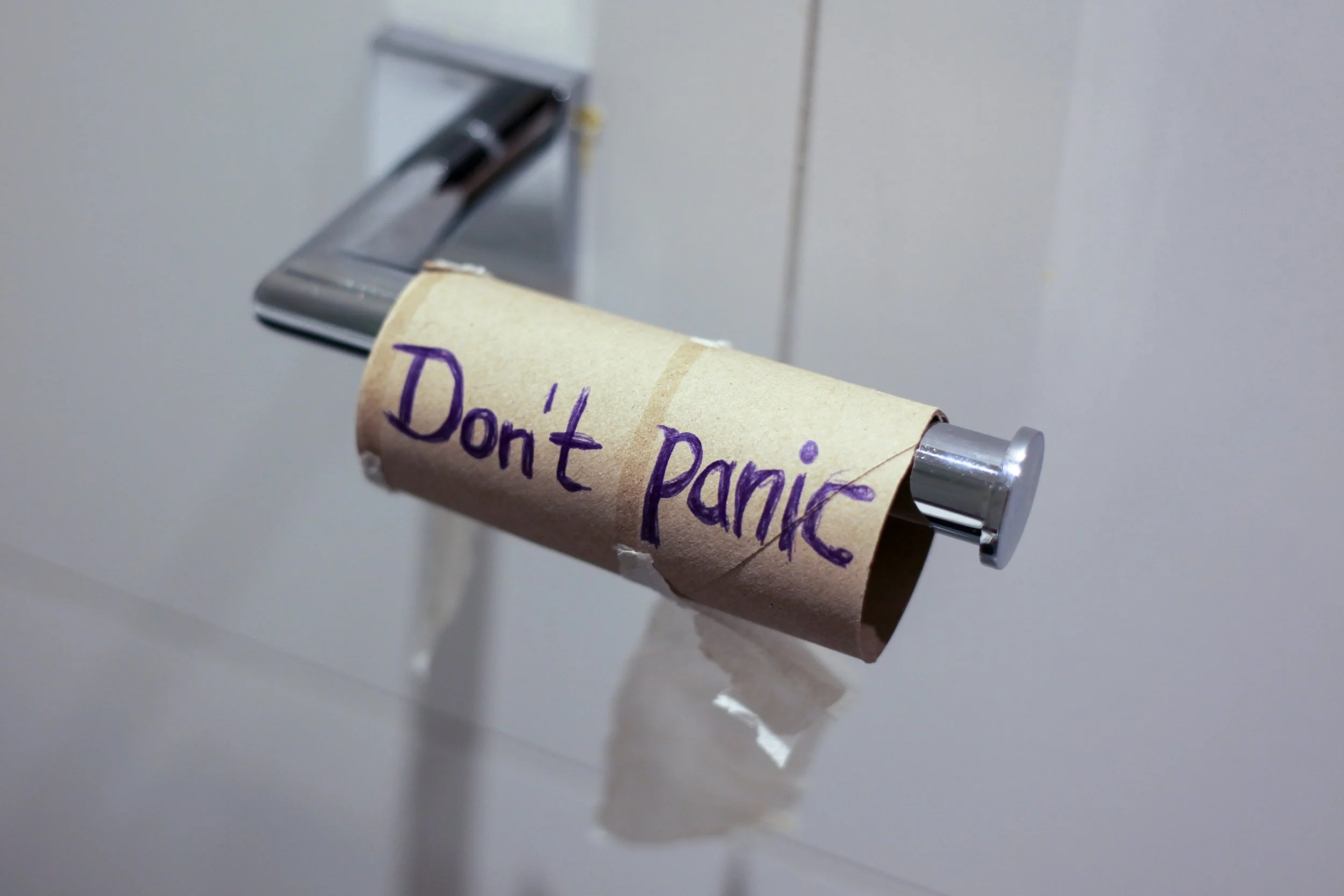
(Picture by Jas Min)
But panic-buying is a self-fulfilling prophecy
Here is the catch: thousands of people, each making a sensible decision at the same moment, create the very shortage they feared. Supply chain researchers describe it exactly this way, as a self-fulfilling prophecy. Products start disappearing, people buy more in response, and the fear completes itself. The instinct is sound but the timing fails, because everyone reaches the same conclusion in the same forty-eight hours.
Which raises a question we mostly skipped at the time: whose job was it to prevent that? Governments told us not to panic buy. Easy advice to give, hollow advice to follow, when nothing had been done to make sure the supplies were there. Worse than hollow, possibly: researchers note that official warnings against panic buying can backfire, because the warning itself draws attention to the coming rush. The Prime Minister announces there is no need to hurry to the supermarket, and the announcement is the starting gun. A state that preaches restraint to households while running its own supply chains with no buffer is asking the shopper to carry a risk that was never theirs.
So if shaming doesn't work, and warnings make it worse, what actually prevents panic buying? The answer is a different way of living.
The car fuel tank analogy
To explain, let me use a car fuel tank analogy. Many drivers wait until the tank is nearly empty before refuelling it. However, I'm inviting you to rethink such an approach. One, because running close to empty is actually detrimental to your car's mechanics. But two, because if you refill when the needle reaches half, you always have fuel to run with. Half is the signal. When your tank reaches its half, you top it up.
Applied to a household, the half-tank rule looks like this. You ensure that every system you depend on is always kept at least half full, all the time. Power: have alternative ways to the main electricity grid, such as solar and batteries, portable power stations or a generator, to keep essentials running when the grid fails. Communications: have alternative ways to reach people when the mobile network is down, such as satellite communicators, satellite internet, UHF radios and more. Food and water: have enough for your household for at least three weeks (more on food security in a previous article of mine). Cash: spare a few hundred dollars in a safe at home as payment terminals are among the first casualties of any outage. Medications: have scripts filled before they run to the last few days.
Now, not everyone has the space or the money for this. Both constraints are real, so the idea is to bend the rule rather than break it. Start with the systems that take no room — scripts filled early, an envelope of cash, a written list of phone numbers, a charged power bank. Add depth one tin at a time, bought on special, which over months costs less than anything bought at panic prices. And where a household genuinely cannot hold a buffer, the buffer has to live somewhere else — in a neighbour's pantry, a community's planning, a social service. Which is, in the end, another reason to plan for more than your own household needs.
The prepared household and the panic buyer are doing the same thing, stocking up against expected scarcity, but the difference is timing. One does it calmly, on an on-going basis, in ordinary shopping trips nobody notices.
Three weeks is not a guess, and it is not a bunker. Flavio Macau, a supply chain academic from Edith Cowan University who tracked every Australian supermarket crisis since 2020, found that all of them resolved in under three weeks, and his advice to households was the same as mine: keep that much on hand, not during a shortage but at the next opportunity, simply so you have peace of mind next time.
To be clear, three weeks is the half mark, not the full tank — it's the level you top up at, never the level you run under. In practice it's a pantry that runs a little deeper than habit, a few jerry cans, a charged battery, an envelope in a safe. Nobody visiting your home would know. But this changes how disruption affects you. When the flood warning comes, or the fire, or the next supply shock, you are not racing anyone to the shelves. You are topping up a system that never ran low. What is an emergency for others, is, for you, an errand.
Even better, don't plan for exactly your household's needs. Plan for more, deliberately. Some of the people around you will not have prepared, or could not, and when the moment comes you can be generous.
Employers have a role too
The same logic scales up, and here I want to speak to employers. An organisation is a household one size larger, and its people are its systems. Unprepared staff carry a cost rarely spoken of, as uncertainty keeps their brain's threat system running, and a mind scanning for danger is a mind unavailable for work. So, when a forecast event is approaching, a flood, say, or a stretch of bushfire weather, give your staff an afternoon to prepare ahead of time rather than scrambling at the last minute; this gives them back a sense of control. The research on sense of control is now strong: feeling in control measurably buffers people against stress, and the effect appears causal, not just correlated.
This is where wellbeing and business continuity turn out to be the same conversation. The employee who has had time to prepare is more likely to still be at work when the disruption arrives, and more able to think clearly while there.
A workforce distracted by what might be happening at home, or displaced because it did happen, is a continuity problem, and a measurable one. Deloitte's work on the cost of Australian disasters now counts employment disruption and displacement among the short-term losses. The drag is on the ledger whether you manage it or not. An afternoon off to let people fill their own tanks is how you remove it.
Then there is the largest household of all. Deloitte Access Economics estimates that disasters already cost Australia around $38 billion a year, rising to at least $73 billion a year by 2060, and that is under a greenhouse gas low-emissions scenario we look increasingly unlikely to achieve. At that scale, the deepest preparedness available to a nation has little to do with stockpiling but is about reducing how often, and how hard, disasters strike. For climate-driven disruption, that means governments should urgently seek to reduce emissions, and actively lead the transition away from fossil fuels. Telling citizens not to panic buy while declining to slow the thing that will keep emptying the shelves is asking households, once again, to carry a risk that was never theirs.
The toilet paper panic-buyers were never the problem. They simply did, in forty-eight hours, what the rest of us could be doing over months. So consider this an invitation. Which of the systems you rely on — power, communications, food, water, cash, medications, fuel — is running near empty right now? Pick one and begin topping it up gradually, in ordinary shopping trips and small decisions nobody will notice. There is no rush; that is the point. A few months of unhurried filling, and the next disruption will find you with nothing you urgently need — able to stay home while others queue, and restock at your leisure once the shelves are full again.