Why One Nation keeps finding an audience
In brief: The rise of anti-establishment politics may have less to do with ideology than with how Australians make sense of an age of disruption.
Not long ago, a conversation with my real estate agent turned to politics. She told me, with evident sincerity, that Pauline Hanson has Australia’s best interests at heart, that she truly understands ordinary Australians and represents them in a way nobody else does. And she reassured me that even as an Australian with a foreign background I had nothing to fear, because I was the right kind of Australian, not Chinese, not Muslim, the kind who had assimilated. I chose to listen rather than push back, but I have been thinking about this conversation ever since.
I am, by most measures, exactly the kind of Australian her reassurance was built to sort and then readmit. I was born in Argentina to a Polish mother, I am French and Swiss, and I have lived in or visited more than sixty countries. I came here twelve years ago and obtained citizenship five years ago. Australia is my home. My two boys were born in this country and their English already outruns their French. So I listened to her account of who truly belongs with a particular kind of attention, as someone she had decided, on sight, to place on the right side of a line I had not known was being drawn.
What struck me when listening to my real estate agent is that there was nothing angry in her, nothing that announced itself as extreme; it was warm, confident, almost neighbourly. The narrative she was relaying is approachable precisely because it is simple, and that simplicity, I suspect, is what makes it so palatable to many Australians navigating a period of real uncertainty.
She is in plenty of company, and Australia is in plenty of company too. Across much of the Western world, parties once considered fringe have moved steadily towards the centre of political life, and countries long regarded as stable liberal democracies are discovering that their stability was perhaps more conditional than they had assumed. In France, my country of origin, the far-right party led by Marine Le Pen is a serious contender to the upcoming presidential election. Here, One Nation remains the most recognisable expression of that politics. It names grievances bluntly, it positions itself against a political class that many people feel has stopped listening, and it keeps returning, election after election, with an audience the major parties would prefer to explain away. Whether one supports or opposes the party seems to me less interesting than the question of why it persists, and what its persistence reveals about the pressures accumulating beneath Australian life.
Because the pressures are real. Housing has drifted beyond the reach of a generation. Household budgets are under sustained strain. Artificial intelligence is beginning to unsettle assumptions about work that most of us grew up inside. Climate change has stopped being a forecast and become, for communities like mine in the Northern Rivers, a recurring lived experience. The world beyond our borders feels less predictable than it did even five years ago, and trust in institutions, never quite as robust as we liked to believe, is wearing thin.
That Australia will face disruption is, I think, settled. What remains open is how people will make sense of it, and who will be offering them the story when they do.
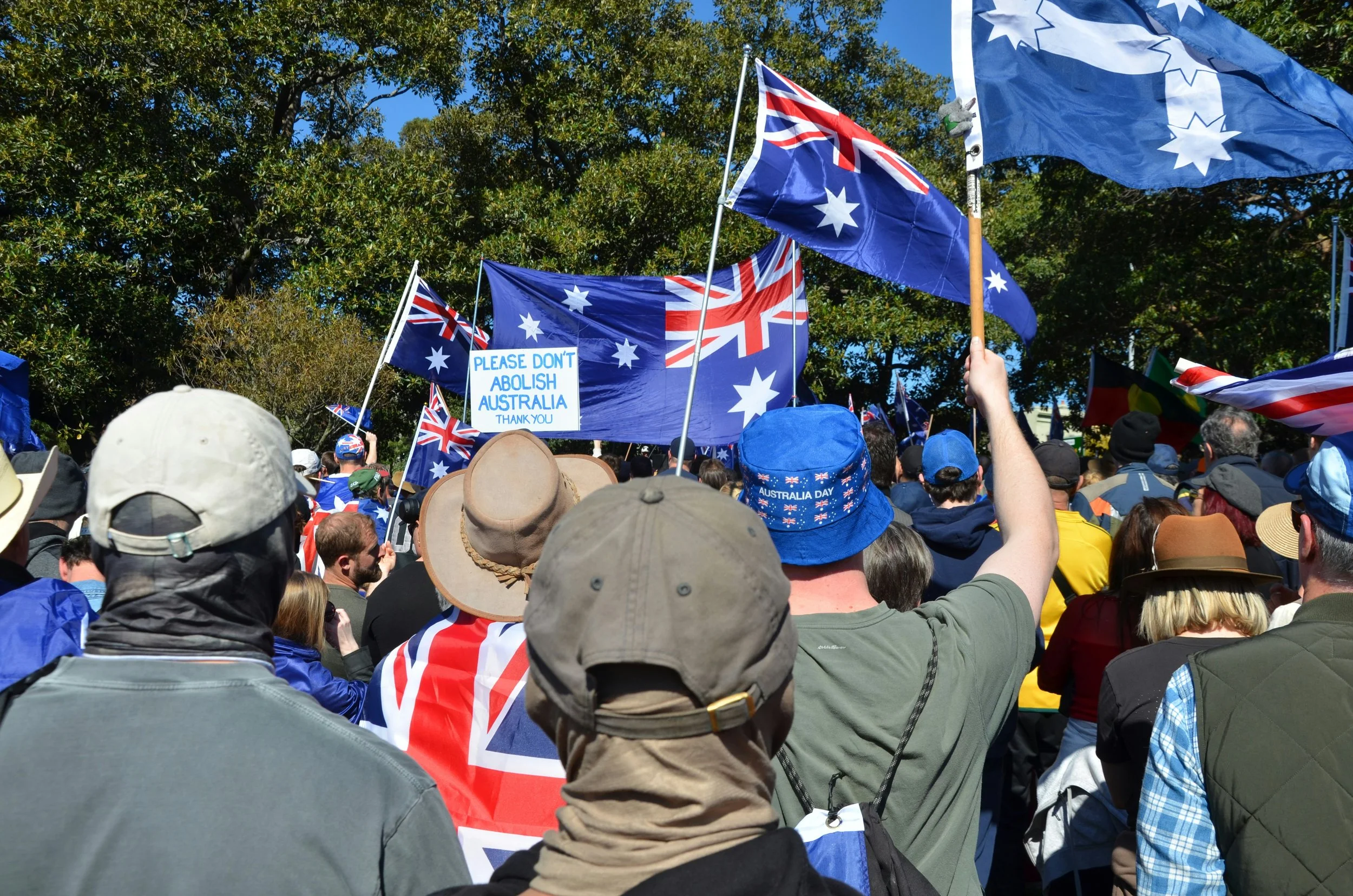
(Picture by Kiros Amin)
The politics of uncertainty
When commentators discuss support for far-right politics, ideology usually takes centre stage. My own sense, formed over twenty-five years of working in places under stress, is that ideology tends to arrive late in the process. What comes first is a feeling: that the world one understood is changing too quickly, and that nobody with power is paying attention.
Australians have lived through extraordinary change over the past several decades — globalisation transformed industries and the towns built around them, digital technologies reshaped how we speak to one another, the economy became more interconnected and, for many people, harder to read. Much of this delivered real benefits, but change dislocates as much as it liberates, and it does not dislocate evenly. Some communities prospered while others watched their reasons for existing migrate elsewhere; some people experienced social change as recognition, others as loss. For those who feel their work, their identity or their place in the order of things slipping, political messages that offer simple explanations begin to resonate.
Researchers studying this pattern across democracies keep arriving at a similar mixture — economic insecurity, cultural anxiety, status loss, distrust of elites, a longing for order — and they keep underscoring that most of the voters involved are not extremists. The Dutch scholar Cas Mudde has spent his career tracing how a politics once treated as outside the bounds of acceptable debate becomes, through repetition and through the willingness of mainstream figures to borrow its language, simply one position among others. But the people drawn to it are, as the political scientists Pippa Norris and Ronald Inglehart argue from decades of survey data across Western democracies, less often embracing its ideas than reacting to a sense that the cultural ground has shifted beneath them, that much of what they once took for granted has slipped to the margins while they were not consulted. They are people looking for a story that explains what is happening to them. Some of the available stories channel uncertainty into solidarity. Others channel it into blame, and blame, unfortunately, travels faster.
Housing and the search for someone to blame
For many Australians, the most immediate anxiety is not ideological at all; it is financial. Housing has become perhaps the clearest symbol of a system whose fairness people have begun to doubt. For younger Australians, ownership recedes a little further each year, renters absorb rising costs with little security, mortgaged households sit exposed to every rate decision, and food, energy, insurance and transport keep claiming more of whatever remains.
But economic stress alone does not produce far-right politics. People endure hardship without turning on each other, as anyone who has spent time in disaster-affected communities can confirm. The danger appears when financial pressure combines with a conviction that the system itself has stopped being fair. When people feel locked out of what their parents took for granted, they go looking for explanations, and the political actors offering the clearest villains gain an advantage. The COVID-19 pandemic sharpened all of this. For a couple of years the state reached into ordinary life in ways most Australians had never known, official advice moved as the science moved, and for a good many people the distance between what they were told and what they felt hardened into a durable suspicion of government and official expertise that has not lifted since.
The actual causes of unaffordable housing are tangled: planning systems, tax settings, investment incentives, construction capacity, and decades of accumulated policy choices. None of it fits on a placard. Blaming migrants, international students or urban elites is much simpler, and this redirection, in which structural problems are converted into resentment of visible groups, is one of the recurring dangers of economically stressful periods.
The underlying concerns about population growth and service capacity are legitimate policy questions; they become corrosive when they are detached from any analysis of the system and attached instead to whole categories of people, many of whom are themselves vulnerable. Part of what gives the grievance its force, I think, is that for a long time these questions were treated as illegitimate to raise at all, so that people with ordinary worries about housing or the pace of change found themselves placed outside respectable opinion before they had finished speaking, and that dismissal, repeated often enough, teaches people that the institutions are not interested in them and that someone willing to give blunt answers is at least paying attention. Far-right politics tends to thrive precisely there, in the gap between real pressure and false explanation.
At the same time, part of this is not really about housing or wages at all. A good deal of the anxiety is cultural, about the pace at which a familiar place can change its character, about languages in the shops one does not recognise and customs one was not raised inside, about the slow loss of a shared world that people had assumed, perhaps without ever examining the assumption, would simply continue. I do not think it serves anyone to treat all of this as bigotry. We are attached to the familiar, a sense of common life is part of how trust and cooperation are built, and change that outpaces the work of making a “we” will be felt by some as loss, however much it enriches the whole. The mistake many governments have made is to refuse the conversation, to treat the discomfort as illegitimate and the people voicing it as beneath argument, which leaves the field to whoever is willing to give the feeling its ugliest form.
And yet there is a line in here that matters more than the rest, and it is the line my real estate agent crossed without noticing. There is a difference between worrying that change is coming too fast and deciding that some of one’s fellow citizens are not really part of the country at all. The first is something a democracy can argue about and act on. The second, the sorting of Australians into the assimilated and the suspect, into the real and the not-quite, is less a concern about culture than a claim about who is permitted to belong, and no amount of legitimate unease about pace excuses it or requires it. The harder task, for anyone who wants to take the anxiety seriously rather than weaponise it or dismiss it, is to hold those two apart.
The same mechanism, everywhere you look
Artificial intelligence is running a version of the same logic through white-collar Australia. Earlier waves of disruption were understood, accurately or not, as threats to manual and routine labour; AI reaches further, and teachers, analysts, lawyers, graduates and public servants are beginning to wonder whether the qualifications they spent years acquiring are rapidly losing their value. The political significance, I suspect, lies less in any eventual outcome than in the uncertainty itself. People can endure difficult circumstances when they can see where they fit in the future; they struggle when they cannot see themselves in it at all, and if large numbers of Australians come to feel insecure despite having done everything that was asked of them, the resulting frustration will go looking for answers.
Climate change carries the same political charge, though its texture is different, because it has stopped being an argument about the future. It is often assumed that disasters build support for climate action, and sometimes they do; I have watched communities discover capacities they did not know they had. But when recovery is slow, bureaucratic or underfunded, as it is often the case, disaster deepens mistrust, and people who feel abandoned begin to see government not as a source of protection but as something distant, indifferent and outright problematic. If climate action is experienced as something done to communities rather than with them, resistance follows, and the politics becomes volatile in ways that favour whoever offers the simplest explanation.
And I do not think those of us who want a fairer and lower-carbon Australia can hold ourselves entirely apart from this. The cultural changes of recent decades, many of which I welcome, were often pursued as though their rightness was self-evident and the people who hesitated were simply behind, and a politics that keeps telling people they are on the wrong side of history should not be surprised when some of them decide they would rather not stand on its side at all. The backlash that Norris and Inglehart describe is, in part, a reaction to a manner as much as to a set of policies.
A more unstable world compounds all of this, as tension abroad makes appeals to borders and sovereignty more persuasive and turns suspicion of foreign influence into suspicion of migrant communities, while social media amplifies each of these anxieties and rewards a certainty that nuance can never match. And the amplification is not only social. In Australia, where much of the press has long sat with a single proprietor in News Corporation, an outlet with a standing commercial interest in grievance gives the simple story a daily platform and a respectable frame that no fringe account could manufacture on its own.
The deeper issue is a widespread search for certainty and meaning during a period of profound disruption. This is where far-right and conspiratorial politics become effective: they provide a compelling, easy to grasp, story. The story may be distorted, but it carries emotional power, because it tells people that their suffering is not random and that someone, somewhere, is responsible. My real estate agent was holding a version of that story, and what she said was not so much hatred but the reassurance of being understood.
Influence without victory
When people imagine the rise of far-right politics, they often picture a fringe party sweeping into government. Australia’s political system makes that outcome unlikely, at least in the near term. The Westminster system, combined with compulsory and preferential voting, creates substantial barriers for smaller parties: winning a sizeable share of the national vote is one thing, converting it into enough lower-house seats to form government is another entirely.
The more plausible scenario is influence without victory. History suggests that political realignments tend to occur gradually, as established parties respond to electoral pressure by adopting positions previously associated with challenger movements. Immigration, national identity, law and order, and energy policy have all shifted this way in various countries at various times, and Australia has experienced a similar dynamic. As housing keeps deteriorating, as AI unsettles employment, and as climate impacts intensify and geopolitical tension grows, frustration with existing institutions will deepen, and the positions of the major parties will move with it. A movement can significantly alter a country’s political direction without ever occupying the prime minister’s office.
The greater likelihood, in other words, is not the rise of a particular party so much as the gradual transformation of the political centre itself, as established parties, responding to the same electoral pressure, absorb positions they once kept at a distance.
Of course, none of this is happening in isolation from the wider world. What can be said in one democracy shifts what becomes sayable in others, and the last decade in the United States has done a great deal to move that boundary. The rise of Donald Trump and the movement around him has taken positions that not long ago sat at the edge of acceptable politics and placed them at the centre of one of the two major American parties, and in doing so it has shown political actors elsewhere, here included, that the old penalties for crossing certain lines may no longer apply. Mudde’s mainstreaming now has a living example behind it, and a One Nation operating in a world where the American right has made so much of this ordinary finds a good deal more room to move than it would have a decade ago.
The standard response, at this point, is a list: invest in housing, strengthen public services, support communities through transition, rebuild trust. All of it may be true, and all of it collides with the question of how it will be paid for. Those questions deserve more space than I can give them here, and I will return to them in a separate article. For now, what matters is the demand side of the equation: why the simple story keeps finding an audience, and what might compete with it.
Resentment or solidarity
None of this means Australia is destined for a far-right future. The pressures that generate resentment can also generate solidarity, and I have seen both, sometimes in the same town in the same day! A disaster that exposes institutional weakness can simultaneously strengthen community networks; economic strain can encourage scapegoating in one street and collective action in the next. The outcome is not predetermined, and what seems to tip it, in my experience, is whether people feel they have agency and a meaningful stake in what comes next. Individuals and communities that are connected and supported respond to disruption differently from those that feel isolated and ignored.
As disruption accelerates, people will reach for stories that help them understand what is happening and where they belong within it. The rise of One Nation is, in this reading, less a story about one party than a signal of the pressures moving through Australian society. The stories we choose to tell will shape whether those pressures feed division or renewal.