What would you eat? On Australia's food security gap
In brief: One in three Australian households experienced food insecurity last year — before the war in Iran, before fertiliser prices doubled, before the El Niño forecasts, before any of this year's pressures had fully landed. It's already a real problem, and it's getting harder. Drawing on original disaster research from the Northern Rivers, this piece examines what genuine food security requires — and what you can do about it now.
What would you eat?
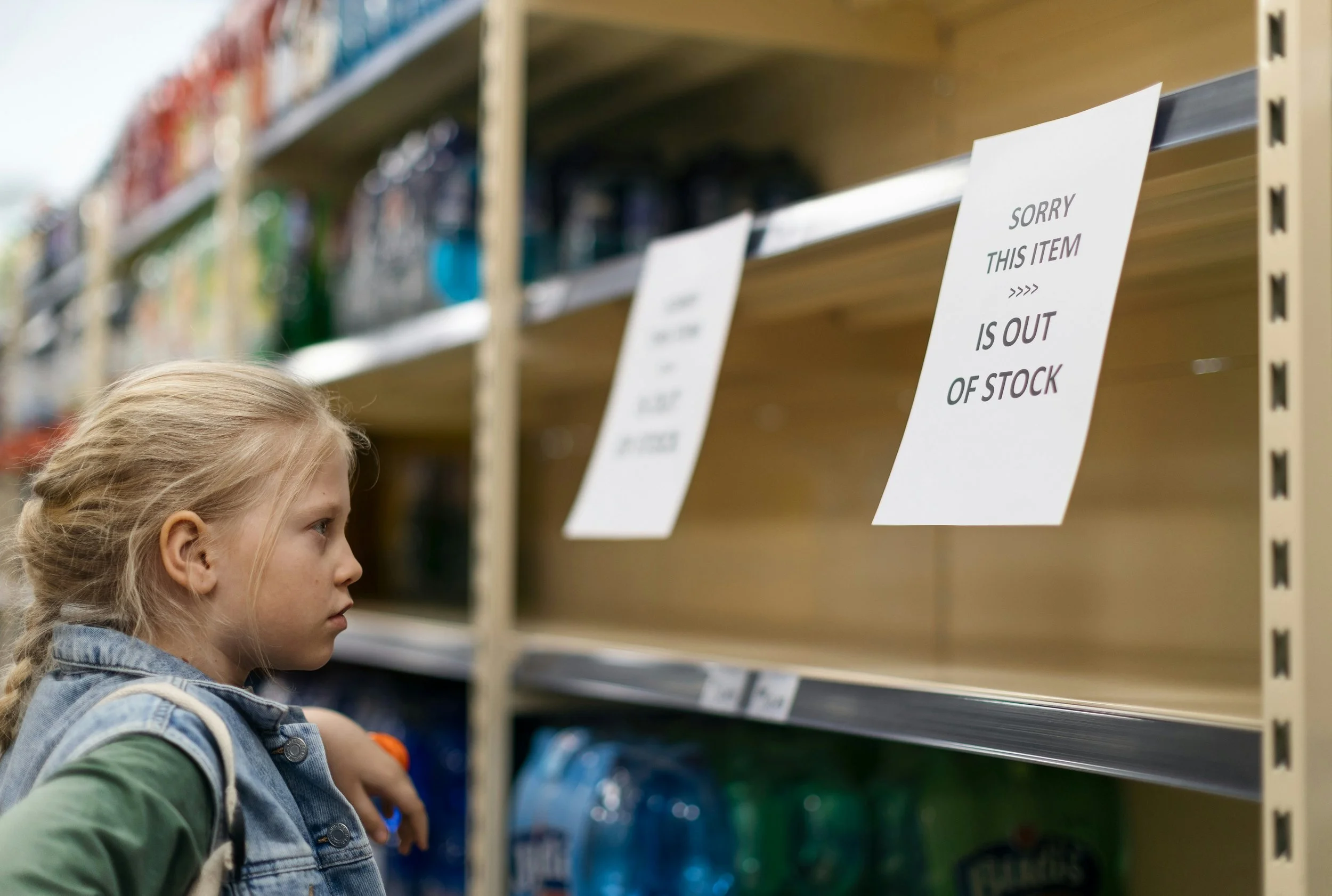
Here is a question worth thinking about before reading further: if supermarket shelves in your city became unreliable for a month — not empty, not catastrophic, just genuinely unreliable in the way that recent events have made plausible — what would you actually eat?
Most people would struggle answering it. The pantry holds perhaps a week of real meals, less if you exclude things that require fresh ingredients you no longer have. More often than not, the cooking knowledge assumes a functioning supermarket. The local relationships — with producers, with neighbours who grow things, with anyone who fishes or forages or preserves — are thin or non-existent. The gap between how capable most Australians feel in their professional and financial lives, and how exposed they are in this one domain, is striking once you notice it.
Before you read further, it is worth knowing that one in three Australian households — 3.5 million — experienced food insecurity in the past twelve months, according to the Foodbank Hunger Report 2025, with one in five households earning over $91,000 also affected. Nearly seven in ten single-parent households are now food insecure, and a similar proportion of households containing someone with a disability or health issue. Food insecurity in Australia is not a fringe problem waiting to arrive. It is a mainstream reality, already present, already worsening, and positioned to deepen considerably as the pressures now converging on food systems take hold.
This piece is about that reality, what is driving it, what genuine food security actually requires, and what each of us can do about it.
(Picture by Getty Images)
What the Northern Rivers showed us
One of the most disaster-tested food system in Australia over the past decade is probably the Northern Rivers region of New South Wales. Bushfires in 2019. Two catastrophic floods in 2022, the second arriving a month after the first. COVID layered across all of it. A cost of living crisis settling in beneath. I co-authored a food security scoping study for this region in 2023, and a companion piece published in The Conversation. I have also delivered food security workshops across NSW and Queensland. What the research documented, and what I encountered consistently in those workshops, was not what most people expect when they think about food insecurity in a region that produces abundant food.
The Northern Rivers grows beef, macadamias, avocados, blueberries, dairy, sugarcane, rice and more. By any national accounting it is food-productive. Yet, after the February 2022 floods, the major supermarkets in Lismore were closed, some for over four months. Supply routes connecting the region to Brisbane's Rocklea markets and to distribution centres in Sydney were severed or severely compromised. Fresh food disappeared from shelves within days. A region that looked food-secure on paper proved acutely vulnerable the moment the supply chains linking it to the national distribution system were disrupted — because those were, in practice, the only supply chains most people's daily lives depended on.
The underlying problem is not unique to the Northern Rivers. Australia's food system is largely structured as a linear supply chain: food grown in a region is trucked out to centralised distribution, then trucked back in to local supermarkets. It is efficient under stable conditions and fragile under disruption, because cutting any point in the chain cuts access to food for the communities at the end of it.
Making food systems genuinely resilient requires thinking of food as a local system rather than a linear supply chain — building the regional circular economies, food hubs and shorter distribution pathways that allow communities to feed themselves from what is grown nearby when the national system becomes unreliable.
What held in the Northern Rivers during the 2022 floods was not infrastructure — most of that failed or was overwhelmed. What held was relationships: the farmers market managers who found alternative venues and pivoted their operations within days; the resident who started cooking meals in her home kitchen for hospital staff and displaced families, eventually producing 1,400 meals a week from donated produce for ten months; the networks between local producers that kept fresh food moving when nothing else was. Local food actors consistently demonstrated greater adaptive capacity than large supermarket chains under disaster conditions, not because they were better resourced, but because they were more connected, more flexible, and more embedded in the communities they served.
But the research also found something harder to make sense of. Even in the Northern Rivers, with its strong local food culture and its abundance of production, most households had no meaningful alternative to the supermarket system when it failed. Access — physical, financial, practical — remained concentrated in the same channels the disaster had disrupted. Local production existed, but the connections between that production and most households did not. This pattern has appeared elsewhere too: in the Pilbara after Cyclone Ilsa cut roads and broke bridges, and in South Australia when floods severed the Trans-Australian railway that carries the vast majority of Western Australia's food supply. It is a structural feature of how Australia feeds itself.
What is converging now
Those structural vulnerabilities are now being tested by pressures that did not exist when the Northern Rivers research was conducted.
The conflict around the Strait of Hormuz — through which roughly one in five barrels of globally traded oil passes — has already moved through energy markets into freight costs and from there into the cost of almost everything that is manufactured, transported or grown at scale. Urea, the synthetic fertiliser that most of the world's staple crops depend on and that is produced from the same natural gas supplies the conflict has disrupted, has seen prices double since February and double again. Australia imports a significant share of its fertiliser requirements, which means global price shifts flow directly into the economics of domestic farming. El Niño conditions are developing simultaneously, bringing reduced rainfall and higher temperatures across key agricultural regions, tightening the same systems already under input cost pressure.
These are not distant or abstract risks. They are active pressures already moving through the food systems that supply Australian supermarkets, arriving into a system the Northern Rivers research found to be optimised for efficiency rather than resilience, dependent on long supply chains with limited redundancy, and carrying far less slack than most consumers assume.
Australia is developing a national food security strategy — Feeding Australia — with $3.5 million committed in the 2025-26 Budget and a consultation process that closed in September 2025. This is encouraging and overdue. The discussion paper's stated priorities centre on resilient supply chains, productivity, innovation and economic growth. These are important. What is less prominent in the current framing is community resilience, household food capability, and the local food system infrastructure — the food hubs, the regional circular economies, the distribution networks connecting local production to local households — that the Northern Rivers research found to be the most critical gap. A food security strategy that focuses primarily on national supply chain efficiency will perform well under normal conditions and leave communities exposed under the compounding disruptions that are now becoming more frequent. The consultation has closed, but the strategy is still being shaped.
My household
My family is further along this than most urban Australian households, and yet, genuinely not far enough.
Over several years my wife has led our household's food security efforts with real skill and sustained commitment. She has completed permaculture training, attended courses in food growing, and delivered food preservation and fermentation workshops to others in our community. She has built a productive garden on our suburban block — under 800 square metres, not ideally positioned, and currently producing a range that would surprise most people: silverbeet, kale, bok choy, rocket, multiple varieties of lettuce and brassica, climbing beans, bush beans, snow peas, sweet potato, taro, cassava, turmeric, ginger, garlic, avocado, mango, citrus, lychee, banana, pineapple, passionfruit, blueberries, and more roots, herbs and climbing vegetables than I can easily list. We have chickens. As a family we fish. We are seriously considering aquaponics — the closed-loop system where fish waste nutrients feed plants and the plants filter the water for the fish — as a next step. We have genuine connections with other local food growers.
My wife recently inventoried what was growing and noted that it still was not close to making us food secure. She is right, and that observation is worth pondering. A suburban block producing that range and depth of food — representing years of deliberate skill-building, genuine knowledge, sustained effort and real community connection — still leaves us substantially dependent on supermarkets for the calories and variety a household actually requires. If that much effort, knowledge and relationship-building is still not sufficient for food security, the scale of what genuine food security requires becomes clearer.
And yet, under the pressure of parenthood and the exhaustion of busy lives, even we have drifted back toward greater supermarket reliance than we would like. The capability is there. The time and energy to fully deploy it is not always. That drift — not from ignorance but from competing pressures — is, I suspect, the most common story among households with some food awareness. It also underscores that to ensure food security, knowledge and intention alone are not sufficient. The conditions that allow people to maintain food practices need to exist and be protected — in household routines, in community infrastructure, and in policy that treats food capability as something worth investing in rather than something individuals are expected to manage alone.
Food security is about access and relationships
The standard food security conversation tends to focus on supply chains, strategic reserves and emergency logistics. These are important of course, but the research I helped produce in the Northern Rivers, and the experience of watching communities respond to compounding disasters, pointed consistently toward something this framing underweights.
Food security is not primarily a storage problem or a supply chain problem. It is, in equal measure, an access problem and a relationship problem.
Access means that food is available, affordable, physically reachable and culturally appropriate for all members of a community — not just those with the financial resources, transport, time and knowledge to navigate a complex food system effectively. The Northern Rivers research found that even when local food production existed and was functioning, many low-income households, households without reliable transport, and households in more isolated communities could not readily reach it. The distribution infrastructure connecting local production to local consumption — the hubs, the cold storage, the logistics, the shortened supply chains — was largely absent. Rebuilding food system resilience without addressing access is a project that benefits the already advantaged and leaves everyone else more exposed, which is precisely the wrong outcome at a moment when food insecurity is already concentrated among the most vulnerable.
Relationships are the other half of the picture. The households and communities that remained food secure under compounding pressure were those with the most active connections: with local producers, with neighbours who grew or preserved or cooked, with organisations embedded in local food networks that could adapt quickly when normal channels failed, with enough practical knowledge to do something useful when the familiar systems became unreliable. Food security built on relationships is qualitatively different from food security built on storage — it is adaptive rather than static, and it tends to strengthen under pressure rather than deplete.
Both dimensions require deliberate investment before they are needed, because neither can be built quickly in a crisis.
What you can actually do
None of this requires a lifestyle overhaul or a move to the country. It requires a series of deliberate choices, made over time, that each reduce dependence and build something that compounds.
The most immediate step is diversifying where your food comes from. A pantry, fridge and freezer stocked with two weeks of real staples — dried legumes, grains, canned fish, oats, rice, cooking oils, and preserved or dried vegetables — provides genuine buffer without requiring much space or expense. Alongside that, finding your local farmers market and using it regularly enough that the relationship becomes real is one of the highest-leverage things a household can do. You are not just buying food; you are building a connection to local production that will matter if the supermarket system becomes unreliable.
Growing food that is relevant in your local climate — even a little — changes your relationship with it in ways that are hard to predict in advance. A few vegetable beds, some herbs, a fruit tree, a handful of chickens if your council permits them: none of these will make you food self-sufficient, but all of them develop knowledge, attentiveness and connection to seasonal rhythms that a purely supermarket-dependent household simply does not have. Learning to preserve and ferment — to extend the life of seasonal produce, to reduce waste, to stock a pantry with things you made rather than bought — is a skill set that takes modest time to develop and pays sustained dividends. It also strengthens your social connections if you invite your family, friends or neighbours, to do it together.
Fishing, foraging and hunting are worth considering if they suit your circumstances and location. They connect you to food sources entirely outside the commercial supply chain, develop practical skills, and tend to embed you in local networks of people who know the same things.
At the community level, joining a food swap, a community garden or a local agriculture initiative builds the social infrastructure that the Northern Rivers research found to be the most effective food security asset of all. These are not to be seen as activities for people with extra time on their hands, but are the connective tissue of a more resilient community. They are built in ordinary times, before the pressure arrives.
Water is worth a separate note. In times of crisis, each person requires roughly four to five litres per day for drinking, cooking and hygiene, which means a two-week supply for a household of four is around 280 litres. A water tank, a collection system, means to filter and sterilise, or at minimum a clear plan for where clean water comes from if the tap becomes unreliable is as important as the food itself.
None of these steps are sufficient on its own. Together, and built gradually over time, they create the kind of layered resilience that makes households and communities genuinely less exposed — not invulnerable, but meaningfully better positioned than those who have done nothing.
What systems need to change
Individual and community action matters, but it is insufficient on its own. The research is unambiguous on this: the households and communities most exposed to food insecurity are not those who have failed to prepare — they are those for whom the structural conditions that make preparation possible simply do not exist. Genuine food security requires systemic change at government and business level, and it requires people who understand what is at stake to advocate for it.
The most important shift governments can make is to treat food as a system rather than a supply chain. Australia's national food security strategy incorporates recommendations to improve productivity, resilience and climate adaptation, but experts analysing submissions to the federal inquiry found key issues left unaddressed, including the structural drivers of food insecurity such as poverty and housing, and the concentration of market power in the supermarket sector. A strategy that focuses on agricultural productivity and supply chain efficiency will improve performance under normal conditions without addressing the fragility that disaster after disaster has exposed. Regional food plans — developed with genuine community participation, connecting local production to local consumption through food hubs, shortened distribution networks and accessible retail channels — are the infrastructure gap that most needs filling. The 2023 federal parliamentary inquiry into food security drew 188 submissions from across the food system and produced 35 recommendations to boost the productivity, resilience and security of Australia's food system. Among them were measures to support local food systems and community food initiatives. As of early 2026, the federal government has not formally responded to those 35 recommendations, despite the publication of the Feeding Australia discussion paper in August 2025. The gap between the quality of the evidence and the pace of the policy response is itself part of the problem.
Protecting arable land from urban development is a related and urgent priority. Across Australia, high-quality agricultural land is being approved for residential and commercial development at a rate that is difficult to reverse and impossible to recover from. Local food system initiatives — including community-supported agriculture, food hubs and food policy groups — improve food quality, dietary diversity, social connectedness and local economies, and have demonstrated success internationally in countries including Canada, the UK and Belgium. These initiatives require land, infrastructure and sustained government support to function at scale. They also require councils and state governments to prioritise food production land in planning decisions rather than treating it as a residual category after housing and commercial development have been accommodated.
For businesses — particularly in food retail, logistics and agriculture — the systemic opportunity is diversification away from single-channel dependence. The supermarket duopoly that dominates Australian food retail has driven out the diversity and redundancy that resilient food systems require. Supporting local and regional producers, investing in shorter supply chains, and building genuine relationships with communities rather than treating them as markets to be served are not just ethical positions. They are commercial risk management in an environment where supply chain disruption is becoming more frequent and more severe.
At every level, the underlying ask is the same: to govern and operate for resilience rather than efficiency, accepting that resilience carries costs that are invisible in normal times and essential in disrupted ones. The evidence from comparable disaster settings is consistent on this point: $1 invested in resilience before a crisis delivers returns of $7 to $15 in avoided recovery costs, according to the UNDRR and multiple independent studies. The Northern Rivers experience — where the absence of coordinated local food infrastructure meant months of empty shelves and ad hoc community response — illustrates what that calculation looks like in practice.
For individuals, the practical form of systemic engagement is advocacy — knowing that your local, regional, state and national strategy are being developed, understanding what they emphasise and what they currently underweight, and making those views known to local councillors, state representatives and federal members. Food system decisions are made by governments that hear mostly from industry. They hear almost nothing from the households and communities who will live with the consequences.
The question again
So — what would you eat?
The question is not really about food. It is about what kind of relationship you have with the systems that sustain you — whether you participate in them or simply consume what they produce, whether you have built any capacity to adapt when they become unreliable, whether you know anyone who grows or catches or preserves things, whether you could feed your household for a week without a functioning supermarket and whether that week would be nourishing or desperate.
My household is further along than most, and genuinely not far enough. The research suggests that most Australian households are not far along at all — and for one in three, the question of what they will eat is not hypothetical but immediate, present, and already painful. Compounding pressure will not create food insecurity in Australia. It will deepen and widen an insecurity that is already here, already affecting households across every income level, and that our food systems — optimised for efficiency, dependent on long supply chains, and largely disconnected from the communities they serve — are not well structured to address.
This question is worth answering honestly. And then, worth doing something about it — at the level of your own household, your community, and the policy conversations that are shaping Australia's food future right now.