Men in crises, men in crisis
In brief: Men run toward disasters that others flee. They pull strangers from floodwater, walk into burning buildings, deploy into active conflict zones on missions that ask them to place the objectives of others above their own survival. They also burn out, shut down, and cause harm in the silence after. This piece is about the courage it takes to run toward fires, the different courage it takes to be honest about what that costs, and what becomes possible when men stop hiding it.
The men who run toward it
In the 2022 Northern Rivers floods, men (and women) of all ages launched tinnie boats into brown water they couldn't see the bottom of to pull strangers off rooftops. Firefighters in the 2019-20 Black Summer ran into walls of fire that consumed whole towns in hours. Soldiers risk their lives far from home, deploying into active conflict zones on missions that ask them to place the objectives of others above their own survival.
These acts are real. The courage is real. The risk is real and sometimes fatal.
They deserve to be received with genuine gratitude rather than taken for granted as simply what people do, and Australia is pretty good at recognising such heroic acts. There is something extraordinary in the human capacity to move toward danger rather than away from it — to subordinate self-preservation to the needs of others, particularly when these are strangers. Many men do this, repeatedly, without ceremony.
This piece begins there, with that acknowledgement, because what follows is complicated — and the complication is not a diminishment. It is an attempt to see the full picture, including the parts that the hero narrative, for all its power, tends to leave out.
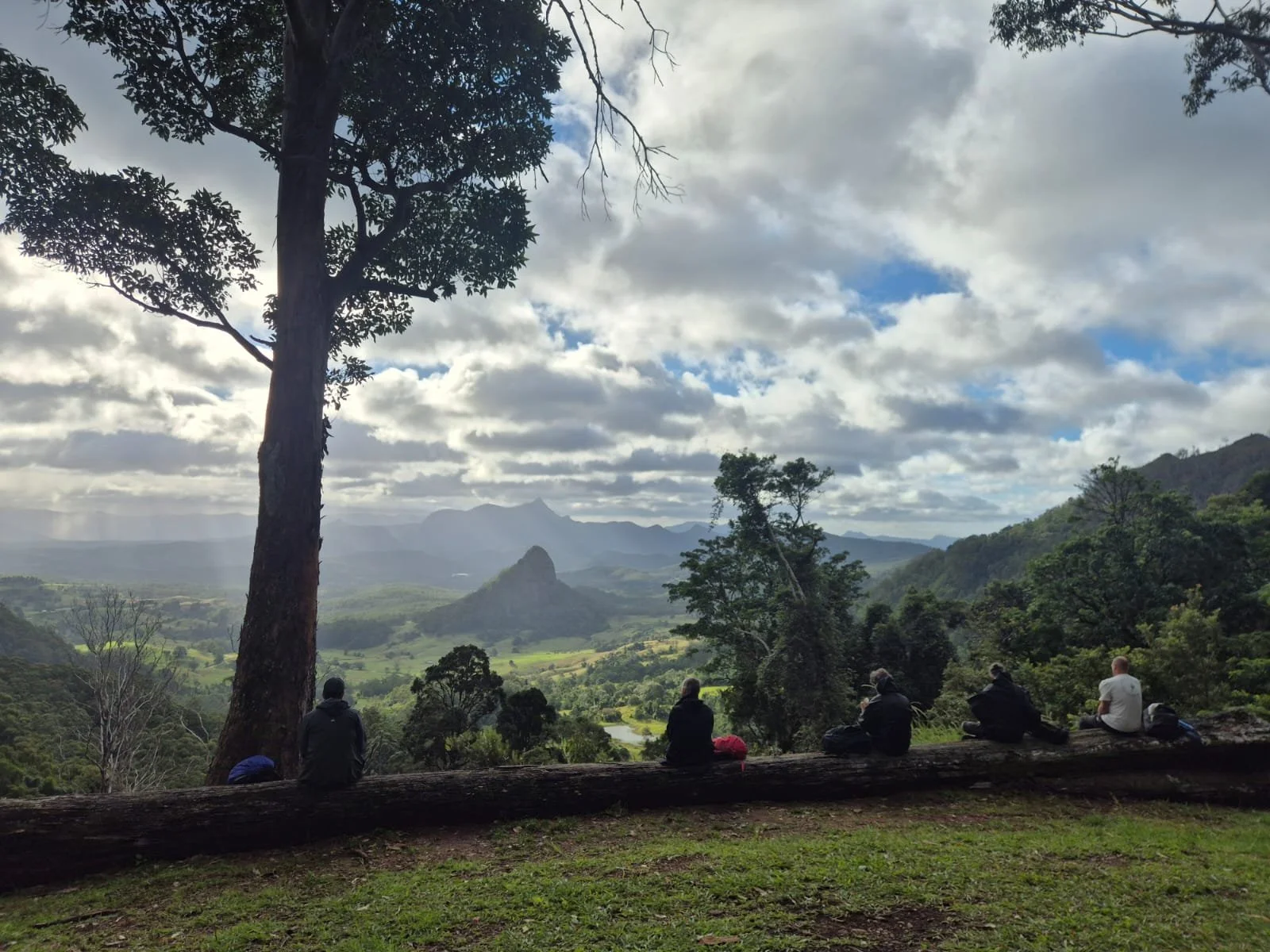
(Picture taken by me)
The problem with heroes
We have become very good at capturing the heroic moment, the rescue, the act, the image that travels. We are considerably less good at what comes after, or at what runs alongside it, unseen, in the same men who perform those acts.
The hero narrative serves a social function. It creates meaning around events that are sometimes random and devastating. But it also creates a trap. The hero is defined by the moment of action. The crisis, for the people living it, lasts years. The hero narrative has no language for the long tail — for the firefighter who can't sleep eighteen months later, for the flood responder who burned out and couldn't care for his own needs, for the soldier who came home and found ordinary life wrong in ways he couldn't articulate to anyone who hadn't been there.
And there is a more specific trap inside the hero narrative: if you are a hero, the role definition does not include asking for help. Heroes help others. They do not become the person who needs helping. The identity that sustained you through the acute phase becomes, in the recovery phase, the thing that prevents you from getting what you need.
The research confirms what practitioners in this space have long observed. First responders — firefighters, paramedics, police, emergency workers — experience significantly elevated rates of PTSD, depression, suicide and substance use. These trends have worsened in recent years, not improved. The men who run toward disasters are, statistically, among the most psychologically at risk in our communities. Not because they are weak, but because what they carry is heavy, and the identity they carry it in does not easily permit them to put it down.
In the aftermath of disasters in Australia, domestic violence rates rise, alcohol and drug use increase, productivity falls, and mental health deteriorates — all while community attention is focused on the visible work of physical reconstruction, and the invisible damage accumulates beneath it. The Ten to Men study — the largest longitudinal study of Australian men in the world — found that one in three men reported having used intimate partner violence by 2022 (year of the big Northern Rivers floods), up from one in four when the study began in 2013. Men with moderate or severe depressive symptoms were 62 percent more likely to use intimate partner violence than men without those symptoms. The connection between men's unaddressed pain and the harm they cause others is not speculative, but documented, longitudinal and Australian.
Yet the violence that follows crisis is not only the kind that makes it into police statistics. There is a slower, less visible kind that accumulates in households and relationships long after the acute phase has passed. The man who was heroic in the flood response but has been emotionally absent ever since. The mental and physical load of recovery — the appointments, the insurance claims, the children's nightmares, the endless logistics of rebuilding — somehow transferred onto his partner without acknowledgement or decision, sustained by gender roles that were accepted without examination and a learned incompetence that exempts men from the domestic labour they are capable of sharing. The gradual closing off, not from hostility but from an inability to process what happened, to locate the feelings, to bring them into the relationship where they could be shared and metabolised together. The children who learn, slowly, not to bring their father their harder emotions because they are unsure how he will receive them.
This is slow violence. Not dramatic, not counted in any survey, but cumulative, and borne primarily by the people closest to the man who is struggling, behind closed doors.
This is why men's mental health is not a private matter, but a community one.
The Australian question
There is a specific cultural layer to this that is worth addressing, because it is not universal, it is ours.
Australia has a particular flavour of stoicism. It runs through footy culture, tradie culture, the bush, through the entire inheritance of a country that admires the man who gets on with it, who doesn't make a fuss, who absorbs difficulty without complaint and keeps going. "She'll be right." "Suck it up." "Toughen up." These phrases carry a genuine resilience tradition, a capacity to not catastrophise, to endure, to find dark humour in hard conditions, but they are also dismissive. They push men to hide their emotions, to pretend all is well when it is not.
Also, the problem is not only what this culture includes but what it excludes. The man who reads poetry. The man who tears at his children's school concert. The man who says I don't know what I'm doing and asks for help. The man who is sensitive, creative, intellectual, or who finds meaning in beauty or ideas or quiet rather than in physical toughness or competitive achievement. These men exist in Australia in large numbers. They are just given considerably less cultural permission to be themselves without apology.
"She'll be right" is simultaneously a genuine coping capacity and an escape hatch from the honest reckoning that genuine recovery requires. It lets you avoid the harder question: is it actually right? And if it isn't, what are you going to do about it?
The rugged, physically capable, practically competent man is a genuinely valuable archetype. But when it is the only archetype on offer, when every other way of being a man is coded as soft, suspect or foreign, it stops being a strength and becomes a constraint. A cage that many men inhabit for decades without realising they built it themselves, from materials the culture handed them before they were old enough to choose.
What I know from the inside
I have spent fifteen years working in some of the most difficult environments on earth and was confronted with unimaginable violence.
In North Korea, I witnessed the malnutrition, the controlled silence, the particular weight of a system designed to prevent people from knowing what they are missing. In Iraq after the fall of Saddam, I experienced the chaos, the disorientation, the strange energy of a world remaking itself in real time. In Congo, the refugee camps, the scale of human uprooting, the shattering powerlessness of watching people lose everything they had built. In Haiti after the 2010 earthquake, whole towns flattened, the organised looting of what remained, the smell of death in the air.
Through all of it, I was genuinely ok. I wasn’t suppressing, but processing. I was functioning, present, finding meaning in the work. And, if I’m honest, even seeking the thrill in the early years.
There is a certain kind of personality that finds clarity in extreme conditions that ordinary life does not provide. A brain surgeon is comfortable cutting through someone's brain. I wouldn’t, but I had my version of such a particular temperament.
Then the 2022 Northern Rivers floods hit me like nothing hit me before.
I know this region. I live here. The people, the streets, the paddocks, the towns are familiar in the way that only home is familiar. And when the disaster came, my sense of what is normal was thrown upside down, quite literally: I saw a cow stranded on the roof of a two-storey house, transported there by floodwater and left when the water receded. I saw shipping containers standing upside down in the air. I saw the institutions we counted on failing in ways that were bureaucratic, impersonal and sometimes cruel. I saw the violence that surfaces when people are frightened and exhausted, the assaults, the egos, the ugliness alongside the heroism.
The surgeon who is calm in the operating theatre is not necessarily calm when the patient is someone they love. The professional distance that holds in every other context may simply not be available here. That is not a failure of toughness but a sign of what it means to belong somewhere.
In 2022, I experienced a deep trauma and clearly burnt out. It took me months to recover and, as part of this, I owned what was mine to own. I rested, reflected, shared. I made the apologies that needed to be made and did the forgiving I could do.
I say this not because my experience is exceptional — it isn't — but because I think it is important to normalise mental health challenges, especially when experienced by someone who is typically a first responder. It is important to say these things out loud as the silence around them is part of the problem.
Thirty men
I recently spent five days on Country with twenty-nine other men — walking, meditating, moving through silence together, sharing meals, being present to each other without agenda. No phones, no roles, no performance of competence. We gathered not in a conference room or retreat centre but in the open air, exposed to the raw elements — rain, wind, sun, in the particular quality of stillness that Country produces. The container was the Dharma: a framework of practice and ethical intention that held the space without controlling it, that created enough safety for what needed to emerge to emerge. The intention was interbeing — not self-improvement or male bonding in the conventional sense, but a genuine encounter with ourselves, each other, and the web of life we are part of and responsible to.*
In that space, men opened up and told their stories. Personal, specific, intimate stories offered to other men who received them without judgement. Men who had lost people they loved. Men who carried rage at their fathers — the inheritance of pain passed down through generations of men who did not know what to do with what they felt. Men who couldn't have erections anymore. Men frightened for the planet, for their children, for the future they were leaving behind. Men angry at other powerful old men — the Putins, Trumps and Musks of this world. Men confused, who did not know what their lives were for.
It became clear over those five days that every single man in that space was hurting or unsure in some way. Not some of them. Not the ones who were visibly struggling. Every one.
These were not fragile men. They were ordinary men — fathers, workers, business owners, retirees, community members, some of them the same kind of men who run toward disasters. Men of all ages, from their twenties to their eighties. And every one of them was carrying something they had not been able to put down, in a context where putting it down was finally, briefly, possible.
What I witnessed was not weakness but the most demanding kind of courage: to be honest about what you feel, in front of other men, without knowing how it will be received. And the equal courage of the men who listened: who stayed present to raw emotion without deflecting it, without fixing it, without making it smaller or more manageable than it actually was.
One research on young Australian men, known as the Orygen study, found that 84 percent feel expected to tough it out and not express their emotions, and 81 percent say those expectations make it harder to seek help when they need it. What I witnessed in that gathering was what happens when those expectations are temporarily suspended — and what becomes possible when they are.
What I have seen work — and what I am trying to do
Every year, around 2,500 Australian men die by suicide. Three times the rate of women. The research is consistent that men are significantly less likely to seek help before reaching that point, shaped by the same norms of stoicism and self-reliance that four out of five young Australian men say they feel.
There are men who need to be held accountable directly. The men who use power to destroy rather than build. The men who convert their own unprocessed pain into violence against the people closest to them. The men who sell a version of manhood through the manosphere that harms boys and girls alike. These things are real and they deserve to be refused clearly, in particular by other men, and certainly not excused or explained away.
But most men I know are not those men. Most men I know carry something they were never taught how to put down, and it causes harm in quieter, more everyday ways because of it. The slow violence described above. The emotional absence. The partner who carries the mental load alone. The children who sense their father is somewhere else even when he is in the room. The love that is real internally but never expressed in ways that is actually felt by others.
In that retreat, I watched men do things that Australian culture does not make easy. They cried. They said ‘I was wrong’. They said ‘I don't know what to do’. They said ‘I am scared’. They said ‘I love you’ to men they had known for four days. And something shifted in the room, not dramatically, not permanently, but deeply and genuinely.
Now, in the hope of stirring the conversation about manhood away from rugged toughness, here is what I have seen work, and what I am trying to practice myself.
Men, share what you are actually feeling with the people around you — not the edited version, not the version that makes you look like you have it together, but the real one. What hurts. What you are frightened of. What you regret. This does not require a dramatic revelation. It can be as simple as saying to a friend that you have been struggling, or telling your partner that you are not ok and you don't entirely know why. The point is not to perform vulnerability but to stop performing its absence.
Reach out to someone you have lost touch with. Not when you are in crisis, but now, while the impulse is available. A friend you have been meaning to call for six months. A family member you have been at distance from. Heck, give me a call. The reconnection does not have to be significant, it just has to happen.
Own what is yours. Say the apology that is overdue, for the harm you caused and attributed to circumstances. Take back the responsibility you quietly handed to someone else.
Say what you feel to the people who need to hear it. Tell your children you love them in ways they can feel, repeatedly, not once. Tell your partner what you appreciate, specifically. Tell a friend that his presence matters to you.
Share the load. Look honestly at what your partner, your family, the people around you are carrying on your behalf, and take some of it back. Not as a transaction but as a genuine reckoning with what you have been exempt from and who has been paying the difference.
Take responsibility for your own health — physical and mental. Book the appointment you have been putting off. See the GP. Talk to someone who can help you make sense of what you are carrying. Men die earlier than women, seek help less often, and wait longer before doing so. That is not toughness but a pattern of neglect that costs men their lives and costs the people who love them their fathers, partners and friends.
Ask for help when you need it. Not as a last resort, not when you are already at the edge, but as a practiced and ordinary thing. The man who asks for help early is not weak. He is the man who is still standing when the people around him need him.
Find a space — a men's group, a retreat, a trusted friend, a therapist — where the performance of competence is not required. Where you can put down what you are carrying, even briefly, and let yourself be seen.
The Ten to Men data tells us that unaddressed pain frequently becomes perpetrated harm. The Orygen data tells us that four in five young men are suppressing what they feel. The suicide data tells us where that ends.
There are no strong men. There are only men hiding their real emotions away — and men who have found the courage to stop.
That courage is not about grand gestures. It is about the small and repeated choice to be honest, with yourself, with the people you love, with the men around you who are probably carrying more than you know. Most of them are waiting for someone to go first. It might as well be you.
*This gathering was the MenAware retreat, facilitated by Ken Golding and Ronny Hickel. MenAware may not be available in this form going forward, but Ken and Ronny's work continues.