Fear, anxiety and climate change
In brief: Fear about the state of the world, and particularly about climate change, is one of the more reasonable responses available to it. This piece is about what a wiser relationship with that fear looks like: staying present to what is being lost without losing touch with what remains, since that is what frees up the energy to actually act. The basic paradox: everything is a mess, yet all is well.
Over the past few weeks, I have found myself having variations of the same conversation with different people, sometimes after a workshop, sometimes just over coffee, and the details change but the feeling underneath them doesn't. People tell me they are scared, and when I ask what of, the answer is usually the state of the world in general and, more specifically, what they are now seeing of climate change with their own eyes. Just this morning I was catching up with a climate scientist who confided that she is terrified. That resonated with me. Here is someone who understands the science, who works with the evidence and knows the uncertainties, and yet ultimately her fear is deeply human and deeply personal: what kind of world will her children inherit?
This northern summer has turned climate change from something described in graphs into something people are living through, and the evidence for that has been hard to miss. Across Canada, hundreds of wildfires have burned through millions of hectares of forest, forcing people from their homes and filling the air with smoke, and in British Columbia alone around 20,000 people have recently been displaced by a major wildfire near West Kelowna. In France, a wildfire tore through the Fontainebleau forest that Parisians love, burning roughly a tenth of it and requiring more than 800 firefighters and, for the first time, the deployment of water-bombing aircraft near Paris to put it out. London's fire crews attended 63 grass fires in a single 24 hours; in Spain, the Sierra Oeste fire burnt about 27,000 hectares across 17 municipalities west of Madrid; and in Greece, more than 1,000 people were evacuated as fires advanced on the western edge of Athens.
Across Europe more broadly, this has been another summer of extreme heat and parched landscapes, with farmers watching their soils dry out and water reserves fall. By July the Danube had dropped to record-low levels in places, low enough to strand vessels on stretches too shallow to navigate and to force nuclear reactors in Romania and Hungary offline or onto reduced output, because there simply wasn't enough river water left to cool them. In England, meanwhile, nearly three-quarters of the country is now under drought status and reservoirs have fallen substantially; in Wales, Henrhyd Falls has run dry for the first time.
Many Europeans are shell-shocked by the sheer ferocity of the wildfires and extent of the damages.
There is something particularly confronting about these images because they translate the language of climate science into ordinary human experience: families leaving their homes, firefighters working in extreme conditions, farmers looking at struggling crops, people breathing smoke hundreds or even thousands of kilometres from the fires themselves.
And then, almost impossibly, elsewhere there is too much water. The images shift from cracked soils and burning forests to streets turned into rivers, homes inundated and communities trying to recover from yet another flood. Heat, drought, fire and flood can sometimes appear contradictory when we encounter them as individual news stories, yet they are part of a climate system in which increasing heat is changing the water cycle and altering the conditions in which extremes occur. What climate scientists have been describing for decades is increasingly becoming something people can see outside their windows, experience in their own communities, smell in the air and feel in their lungs.
Behind these immediate events, the longer-term data tell an equally concerning story. A major assessment of the state of the global climate in 2025 found concentrations of the three main long-lived greenhouse gases, carbon dioxide, methane and nitrous oxide, continuing at unprecedented levels, while exceptional temperatures were recorded across much of the planet. Europe experienced its warmest year on record. The Arctic and Antarctica both recorded extraordinary warmth, and glaciers around the world continued their long-term loss of ice.
All of this is happening at a time when political commitment to addressing climate change appears to be weakening in some countries, while wars, geopolitical tensions, economic uncertainty, rapid developments in artificial intelligence, biodiversity loss and political polarisation add further layers of uncertainty. Researchers increasingly use the term polycrisis to describe these interactions between crises, where disruption in one system can amplify vulnerabilities elsewhere.
I have spent much of the past 25 years around disasters, first as an aid worker in war zones overseas, then in Australia as a firefighter and community resilience practitioner through bushfires and floods. Like many Australians, I have seen what happens when the systems we take for granted begin to fail, roads cut off, power down for days, supermarket shelves stripped bare within hours. I have seen emergency services stretched beyond capacity, and communities left to carry the long tail of recovery for years after the cameras have gone. You could say I’m well versed in disasters and disruptions.
Yet what I have watched unfold across the Northern Hemisphere these past weeks has filled me with dread, partly because France is my original home country and my family is there, and more deeply because the hazards themselves are moving beyond familiar limits. ‘This is it’, we’ve woken up the climate change beast.
Europe is living its own Black Summer, the moment climate change leaves the scientific reports and enters people’s lives. So, when people tell me they are frightened, I immediately think how natural such a response is.
Isn’t anyone paying attention not afraid about what’s happening? Isn’t anyone paying attention not anxious about what’s to come given that this year’s Northern Hemisphere summer is likely to be considered mild in a decade or two?
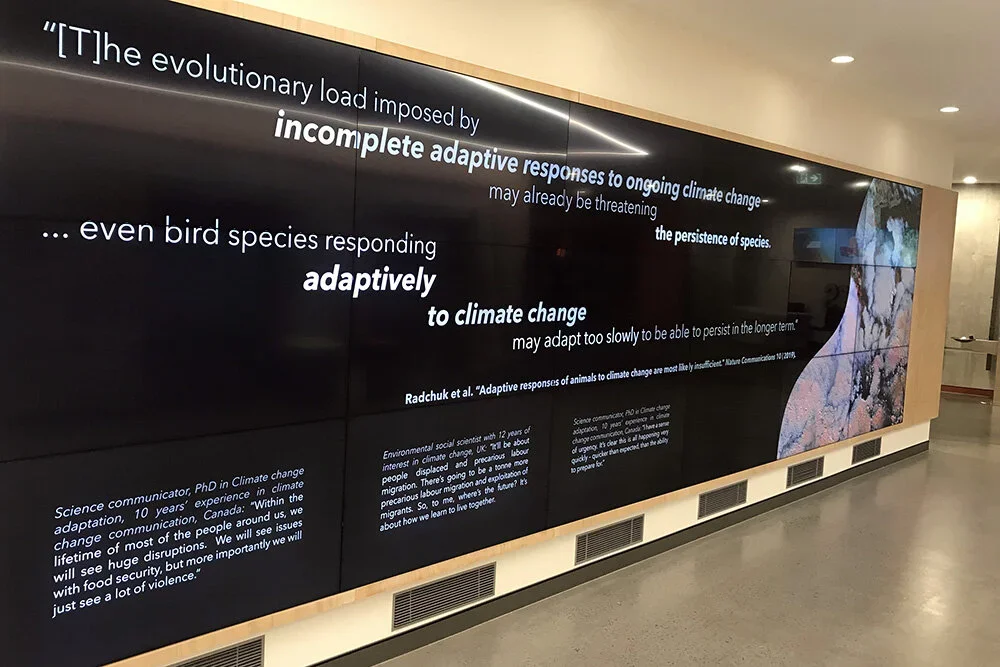
(Picture of an art piece I co-created - details below)
What if fear is an appropriate response?
Psychology draws an important distinction between fear and anxiety. Fear usually arises in response to a threat that we perceive as real and present. Anxiety is more often associated with uncertainty, anticipation and the many futures our minds imagine. Climate change sits somewhere between the two. It is no longer simply a future possibility as we are already living with its consequences, while also anticipating changes that remain uncertain in their timing, scale and consequences.
From an evolutionary perspective, fear is not a flaw in the human condition but one of the reasons our species survived. Fear sharpens our attention, prepares our bodies for action and reminds us that something precious may be at risk. When the threat is real, fear can be an entirely healthy response.
Our understanding of fear has understandably been shaped by medicine and psychology, both of which have transformed countless lives. When fear or anxiety becomes overwhelming, begins to dominate everyday life or develops into a clinical condition, seeking support from a GP, psychologist or psychiatrist can be life-changing. Evidence-based therapies and, where appropriate, medication have helped millions of people regain stability, perspective and wellbeing.
At the same time, I sometimes wonder whether our culture make us think that fear is something to eliminate. That may well be true when fear has become disconnected from reality or is preventing someone from living their life, but when we are responding to genuine threats, perhaps the question is different. Perhaps the challenge is not how to get rid of fear, but how to develop a wiser relationship with it.
This is where resilience, for me, becomes something quite different from toughness or positivity.
Over the years, through working alongside communities affected by disasters, through mindfulness practice, and through conversations with people trying to make sense of an increasingly uncertain world, I have become less interested in eliminating fear than in learning how to hold it without allowing it to occupy the whole landscape of my life.
That begins with returning to the body. Whenever I notice my mind racing ahead into imagined futures, I try to come back to something immediate: the sensation of my feet on the ground, the rhythm of my breathing, the feeling of wind on my skin. I have learned that presence is less about stopping thoughts than about remembering that I do not need to follow every one of them. Sometimes this happens through meditation. Sometimes it happens while walking through the bush, creating art, woodworking, writing or simply sitting quietly in my non-thinking chair. These moments do not make uncertainty disappear but they remind me that my life is always lived here, in this moment, rather than entirely inside the stories my mind creates (ruminates!) about tomorrow.
Taking action can also help change our relationship with fear and anxiety because it restores a sense of agency when so much feels beyond our control. The action does not need to be heroic, nor does it need to solve the problem on its own. It might mean reducing our own environmental footprint, preparing our household for future disruptions, joining a local community or climate group, supporting organisations doing meaningful work, contacting political representatives, participating in collective advocacy, helping build resilience in our neighbourhoods, or simply having conversations that help others engage with what is happening. Acting on what matters to us can turn some of the energy of fear into purpose and remind us that, even within enormous systems over which we have limited control, we still have choices about how we respond.
I have also come to believe that this is not something we do alone. Long before psychology became a profession, human beings gathered to make sense of uncertainty together. They shared stories, listened deeply, mourned losses and reminded one another that they belonged to something larger than themselves. Modern neuroscience increasingly confirms what communities have always known: our nervous systems are profoundly relational. Being listened to with care, sharing our fears honestly, hearing how others are making sense of the world and discovering that we are not carrying these questions alone all help us relate differently to uncertainty. Community resilience begins with these ordinary acts of human connection.
A creative exploration of climate uncertainty
These questions have accompanied me for many years, not only through research and writing but also through creative practice. Several years ago, I began collaborating with my friend and former colleague, media artist A/Professor Grayson Cooke, because we both sensed that some experiences resist explanation. We can understand climate change through scientific reports, satellite imagery and risk assessments, yet that does not necessarily help us experience what it means to live with this knowledge.
Our collaboration grew out of academic research I had been conducting with climate scientists around the world. In 2018 and 2019, I interviewed sixteen leading climate experts across thirteen countries and then surveyed close to a thousand climate experts in 83 different countries. I was not interested so much in the climate science, which I was already familiar with, but more in how their knowledge of climate change had entered their personal lives. And so, I found myself asking each of them the same questions, knowing what they know about the science, what choices have they made, or were they making, in their own life, and in the lives of your children and grandchildren? In other words, how did they respond psychologically, practically, socially and ethically to what they knew?
The questions move climate change out of the abstract and into the ordinary decisions that make up a life, from where we choose to live to how much we let preparation organise a family’s days, and the responses I received were diverse, though climate change had clearly permeated the personal lives of many participants far beyond their formal work. They made sense of it through scientific knowledge, direct experience, emotion and the wider political and social world around them, and what began for many as a professional field had gradually changed how they understood the future, and their own place in it; there was no single prescription for how to live, but there was broad agreement about how serious what was unfolding really was.
Grayson brought another dimension to those questions through his collaboration with Geoscience Australia and his remarkable work with satellite imagery. Together, we created Adapt, Mitigate, Innovate, Unite, combining excerpts from conversations and exchanges with climate experts with large-scale satellite images of the Earth. We were less interested in communicating more information than in creating an experience that invited people to inhabit two truths at once: to recognise the seriousness of what is unfolding while remaining open to the extraordinary beauty and wonder of the living world.
Our project culminated with it being showcased on the incredible LED display system on the Adelaide Festival Centre in South Australia, playing at the festival throughout July 2020. In addition to its design for the Adelaide Festival Centre, pilot versions of the project were developed for the Southern Cross University “discovery wall” videowall systems in Lismore and Gold Coast, from which the picture above was taken.
If you have a few minutes, I encourage you to spend some time with the work. It’s equally confronting and beautifully dazzling, and that’s the point.
There's nothing to interpret here, only to notice what it brings up in you.
I also co-created with the support of two students, a series of short social media videos to reach a younger audience, titled Let us pause for a moment of science and shared these on different medias. One short episode is shown here:
It was only after years spent inside these questions that I came across words that said what I had been reaching towards all along, a line from the Zen teacher Ezra Bayda: “The basic paradox. Everything is a mess, yet all is well”.
The world is a mess, and all is well
I don't hear those words as optimism, nor as an invitation to deny what is unfolding around us. I hear them as describing a different way of inhabiting reality. The challenges before us are real and looking away from them serves no one. At the same time, beneath our thoughts about what may happen next, there remains this moment. The warmth of sunlight through a window. The sound of birds at dawn. The quiet presence of someone we love. The feeling of breathing in and breathing out. None of it erases the crises we face, but it reminds me that awareness is spacious enough to hold grief and beauty at the same time, fear alongside gratitude. The more time I spend letting my ruminating mind settle, the more I notice something underneath it that feels like a deep inner peace, not manufactured, just there once the noise clears, in the way a room feels different once you stop pacing in it. That peace tends to bring joy and gratitude along with it. And underneath that, I find something steadier in myself, a kind of clarity, and under that again, something I can only really call love for what is, all of it, as it actually is.
We often use the image of a glass that is either half empty or half full, as though we have to choose between pessimism and optimism, with the pessimist reading the data while the optimist watches the sunrise.
I have come to think a better way of looking at it is developing the capacity to see both at once, and I do mean developing it, because it does not come naturally to most of us. Fear draws our attention towards the empty half until it fills the whole frame; comfort and denial draw us the other way, until the losses disappear from view entirely, and both are distortions that carry real consequences.
As confronting and overwhelming as it is, seeing the empty half clearly lets us understand risk and prepare for what is coming, while seeing the full half clearly reminds us why any of that work is worth doing and gives us some of the strength to keep doing it. Holding the whole glass means facing what is being lost without flinching, while staying connected to what remains: the relationships and the ordinary possibilities that still make life worth living. And in a strange ironic turn, I find that the more I acknowledge the half empty glass, the more I fill it up by simply letting it be.
We can be fully present to a damaged and changing world without concluding that every moment of life is itself damaged, and that we can recognise real suffering while still falling in love, still noticing the ordinary beauty in front of us.
What radical acceptance looks like
A podcaster once asked me how I cope with the sheer volume of catastrophic news, and all the suffering behind it. I accepted a long time ago, back when I was a teenager devouring books about wars, including the Holocaust, that we humans have this capacity to perpetrate atrocities against each other on an industrial scale. That's just a dark part of the human condition.
Psychologists and social researchers have spent decades trying to explain how ordinary people become participants in violence like that, obedience to authority, dehumanisation, the slow normalisation of things that would once have seemed unthinkable, and history shows those capacities are present in any society when the institutions and conditions around people enable them. Accepting that has never meant becoming indifferent to suffering. For me it has meant giving up the expectation that humanity will somehow reach a point where cruelty disappears, while still believing we have an equally human capacity to care for one another, to cooperate, and to act with real courage and compassion.
The same applies to climate change. I won’t describe it here as Richard Hil and I explore it extensively in our book Unspeakable, but in a nutshell, the climate catastrophe we are living through is also profoundly human-made, and its persistence cannot be understood through carbon emissions alone. It involves political ideologies and economic systems that reward short-term extraction, greed and the concentration of power, vested interests and corruption, alongside some very human psychological tendencies: our difficulty perceiving slow-moving and distant threats, our preference for immediate rewards, our capacity to normalise worsening conditions, and our remarkable ability to deny or rationalise realities that threaten our identities, interests or ways of life. None of these mechanisms make our current trajectory inevitable, but they help me understand why, despite knowing about climate change for decades and possessing much of the knowledge and technology required to respond, humanity continues to struggle to act at anything like the scale and speed the crisis requires.
People sometimes ask me what radical acceptance looks like in practice, and for me it starts with ending my argument with reality: I do not like what is happening, but refusing to accept that it is happening leaves me with less energy to respond to it. Acceptance, as I use the word, means recognising that this is where we are starting from, whether we would have chosen it or not.
I have come to accept that climate change is happening, that some of its consequences will be devastating, and that we won't be able to prevent all of the suffering and loss still to come. Such acceptance doesn't mean resignation, or giving up on mitigation of greenhouse gas emissions, quite the opposite: every fraction of a degree still matters, and so does every effort to protect the people, places and ecosystems we can still protect. What it does mean is accepting that we can't control how this story unfolds, and that our task is increasingly to learn how to live well, and responsibly, inside that uncertainty.
In other words, none of this removes the obligation to act, and I do not experience radical acceptance as a withdrawal into private serenity while the world burns; if anything, it frees up energy that denial and panic would otherwise burn through, and that energy is what goes into the actual work, cutting emissions, getting homes, communities and organisations ready, and making sure the people with the least capacity to adapt are not left to manage alone.
What steadiness alone cannot do
Fear can sometimes open the door to deeper inner work, though there is nothing inevitable about that: suffering can open people up, but it can also overwhelm them, or wear them down until they have less left to act with. Gratitude and presence should not become one more obligation for people who are already struggling; at their best they are practices that help us stay human and engaged, especially when we do them together.
That fear is sane does not make it easy to carry, and no one should be expected to carry it alone. Inner steadiness helps, but it is not a substitute for safe housing, functioning institutions and the resources people actually need to adapt, or for governments competent enough to help provide them. We need both: the inner capacity to stay present, and the collective capacity to look after one another.
Paying attention
Perhaps that is what Adapt, Mitigate, Innovate, Unite was really about all along: making space for fear without letting it become the only story we tell ourselves. The years ahead may be difficult, harder than many of us would like to admit, and that possibility deserves to be spoken about plainly and prepared for, rather than managed by postponing our lives until the danger passes, since there may be no clean point where the work finishes and the uncertainty lifts.
Holding the whole glass means looking straight at what's changing without losing touch with what's still alive in front of us, grief sitting next to gratitude, urgency next to presence. It means doing what we can to protect and repair, and it means carrying on, building lives and communities that still have room in them for love and for beauty.
Fear is part of that work because it tells us that something we value is at risk, and it need not be the end of the story; it may instead be one of the ways we learn to pay attention. Perhaps resilience begins here. Not in becoming fearless, and not in pretending everything will be alright, but in cultivating the capacity to remain present to reality in all its complexity, to return gently to the body when the mind races ahead, to seek the company of others when fear becomes heavy, and to continue finding meaning in the midst of uncertainty.
The future remains unwritten. How we choose to inhabit the present is still, thankfully, ours.
"The basic paradox. Everything is a mess, yet all is well."
Need help applying these ideas inside your organisation? I work with boards and executive teams to build crisis-ready capability across leadership, culture and systems.