Stop preparing for the next disaster. Start preparing for a lifetime of disruption
In brief: September is a good time to prepare for the coming disaster season, but preparedness now needs to mean more than emergency kits, evacuation plans and clearing gutters. We also need to think about the cascading consequences of disasters, the people and systems we depend on, our psychological capacity to cope with disruption, and the resilience of the organisations and communities around us. More fundamentally, we may need to stop thinking of preparedness as something we do for the next emergency, and start thinking of it as a long-term capability for living through a more uncertain and disrupted future.
September is increasingly becoming the month when Australians are reminded to prepare for the coming summer and the disasters it might bring. I think this is a very good thing. We know enough by now to understand that preparation is important, that there are things we can do before a bushfire, flood, cyclone, storm or heatwave that can make an enormous difference to what happens during and after it, and that waiting until we are frightened, tired, the road is closing or the power has already gone out is generally the worst moment to start making consequential decisions.
So, yes, let’s use “Preptember” to prepare: clean our gutters, clear vegetation, check our emergency plans, understand our local risks, review our insurance, think about evacuation routes, and make sure we have medications, water, food, batteries, torches and whatever else our circumstances require. It also helps to know where we will get trusted information, what we will do with our animals, how we might keep our phones charged if the power fails, and whether everyone in our household actually knows the plan or is assuming that someone else does.
There is already a great deal of good advice available on these things, provided by emergency services, councils, health agencies, utilities, insurers, community organisations and others. The advice itself is generally sound. My concern is that it arrives in fragments, because organisations communicate through the responsibilities they hold: fire agencies focus on fire, flood agencies on floods and storms, health authorities on heat and health, utilities on disruption to essential services, and so on. A disaster, though, arrives whole. We experience it as complete human beings, living within households and communities, connected to workplaces, schools, businesses, infrastructure, ecosystems and other people, with all the dependencies, vulnerabilities, relationships and emotions that come with that.
This is why I think we need a broader understanding of preparedness, one that brings together the practical, the social and the emotional, psychological and even existential dimensions of resilience, while also thinking beyond the immediate hazard to its cascading consequences. And increasingly, I think we need to extend the time horizon too. We are certainly preparing for the coming summer, but in reality many of us are also preparing, whether we acknowledge it or not, for a lifetime of greater exposure to natural hazards, climate disruption and the wider economic, social, ecological and geopolitical instability within which those hazards are increasingly occurring.
That requires something more substantial than an emergency kit.
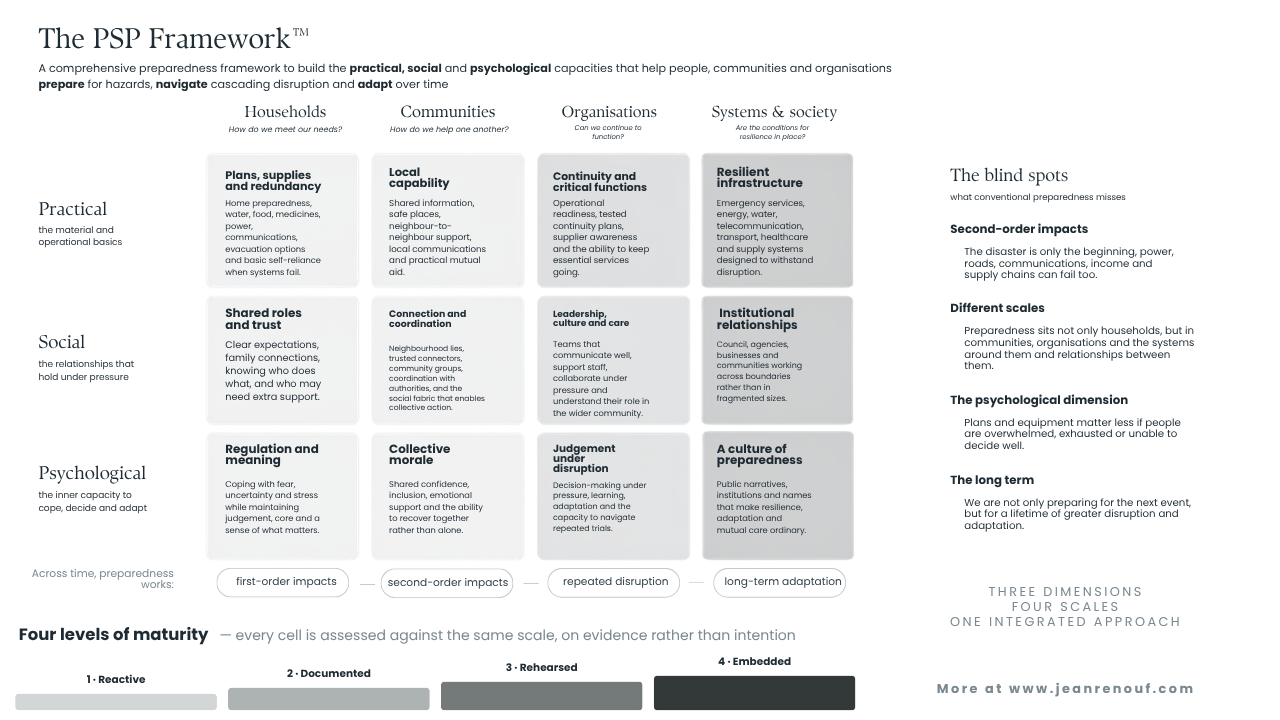
A framework to guide preparedness
The framework I tend to use for thinking about resilience, which I have started referring to as the PSP Framework, for practical, social and psychological preparedness, brings together three dimensions that are too often treated separately.
Practical resilience covers the tangible things we need to function through disruption: plans, supplies, infrastructure, communications, skills, redundancy and the capacity to meet basic needs when normal systems fail. Social resilience is about the relationships, networks, trust and collective capabilities that allow us to help one another, share resources, improvise and organise when circumstances exceed what any individual household can manage alone. Psychological resilience concerns our capacity to cope with uncertainty, stress, fear, grief and change while continuing to think, make decisions, care for others and retain some sense of meaning and agency. I sometimes extend this third dimension into the existential, because prolonged disruption eventually raises deeper questions about what we value and how we live well in circumstances we cannot entirely control.
Each dimension leans on the others. A well-stocked household can remain vulnerable if its relationships are weak, and all the plans and equipment in the world are of limited use to someone who becomes psychologically overwhelmed at the moment they most need to act.
The same three dimensions can also be considered at different scales, from households, to communities, organisations and businesses, and ultimately the wider systems and institutions upon which all of them depend, and across different time horizons, from preparing for an immediate hazard and its cascading consequences through to adapting to repeated disruption over years and decades. Real preparedness means working across all three dimensions, at all these scales, and over time.
Preparing for the disaster, and for what follows
The first part of preparedness remains relatively straightforward: understand what can happen to you, and prepare as well as reasonably possible for it. This is what I would think of as preparing for the first-order impact.
A first-order impact is the direct effect of the hazard itself: the fire, flood, heatwave, cyclone or storm, and the immediate damage it causes. A second-order impact is what follows from that disruption: power outages, road closures, communications failures, supply shortages, loss of income, service interruptions and other cascading consequences.
If you live in a bushfire-prone area, the first-order question is what happens if fire approaches your property. If you live near a river, creek or coastline, it is what flooding looks like at different levels, and which roads disappear first. Heat deserves the same concreteness. Consider a household during several consecutive days above 40 degrees. The house may be perfectly liveable on the first afternoon, and even on the second, but if the electricity fails under region-wide air-conditioning load the picture changes hour by hour: the fridge warms, the fans stop, the house holds its heat overnight, sleep breaks apart, and an older relative who was coping well on Monday may be in genuine danger by Thursday. The exercise is to follow your own exposure through at that level of detail.
These are practical questions, and I think we should become much more comfortable asking them without interpreting the exercise as catastrophising. Risk awareness does not require living in fear. I wear a seatbelt without spending the journey imagining a crash, and the smoke alarms on my ceiling have never once kept me awake at night. Preparing for foreseeable disruption is simply part of taking responsibility for ourselves and the people who depend upon us.
But this is only the beginning, because disasters very rarely remain confined to the hazard itself.
The water, the fire, the wind and the heat are only the most visible part of the event. Each sets off a chain of secondary consequences that sometimes reaches people whose homes were never directly threatened by the original hazard. Electricity fails and takes telecommunications and electronic payments with it; roads close, so fuel becomes hard to obtain and supermarket shelves empty; schools shut and businesses stop operating, which means medical appointments are cancelled, people cannot get to work, and income disappears at precisely the point that unexpected expenses are increasing, while beneath the logistics, trauma and loneliness deepen and domestic violence increases.
This distinction between first- and second-order impacts is important because it changes the question we ask ourselves. Instead of only asking, “Will my house survive the hazard?”, we also start asking, “What systems does my life depend upon, and what happens if some of them become temporarily unavailable?”
You may discover, for example, that the flood risk to your home is very low but that the only roads connecting your community to the outside world are vulnerable; that your house is relatively well protected from bushfire while your electricity supply is exposed; that your family can cope without power for an evening but, because of medical needs, heat, refrigeration or communications, could not manage several days; or that your business depends upon one supplier, one system, one site or one person whose absence could stop the whole operation.
Preparedness then becomes a matter of understanding dependencies and creating alternatives where we reasonably can, and only sometimes a matter of collecting things. Sometimes that will involve equipment or supplies. Sometimes it will involve information, skills, relationships, redundancy or simply having thought something through before we are required to act.
Preparing with other people
There is an assumption embedded in much of the way we talk about disaster preparedness that deserves closer examination: the idea that preparedness resides primarily within the household.
Of course households should prepare. There are things governments, councils, agencies and emergency services simply cannot do for us, particularly during the first hours of a large emergency when professional resources are inevitably limited and demand can vastly exceed what is available.
The opposite conclusion deserves scrutiny too. Retreating into ever more self-sufficient individual households misreads how disasters actually unfold.
We know from disaster after disaster that people turn to other people. Neighbours check on neighbours, strangers rescue strangers, people share generators and information, cook food, clear debris, move animals, offer spare rooms, collect children, provide first aid and work out solutions that nobody planned in advance. This spontaneous mutual help sits alongside professional emergency management as part of how societies actually function under stress.
So one of the most useful things we can do during Preptember costs nothing and requires no equipment: getting to know the people who live around us.
Take one figure who exists in almost every community: the person who has lived beside the local creek for forty years. They can read it in a way no gauge or app can, because they have watched what it does after two days of rain on an already saturated catchment, and they can tell you which paddock floods first and which road becomes impassable well before the warnings say so. Their knowledge only becomes useful to you, though, if the relationship exists before the water rises. The same is true of the neighbour whose medical equipment depends on electricity and who may need someone at the door within hours of an outage, and of the household with small children two doors down, and of the person with the tractor, the chainsaw, the UHF radio or the ute that can get through when your car cannot, and of the person who lives alone and could drop from sight for days without anyone noticing. Knowing who is around you and what they might need or offer is preparedness of a very practical kind.
And, importantly, so is asking what we might be able to contribute ourselves.
There is a subtle but profound difference between preparing ourselves against everyone else and preparing with everyone else. I have written before about the limitations of an individualistic “prepper” model of resilience. Storing food, water or equipment is often eminently sensible; the worldview within which those things sit is what skews. A shed full of equipment surrounded by weak relationships may well prove less resilient than a modestly prepared household deeply embedded within a capable and connected community.
Our preparedness is partly held in the people around us.
This is why strengthening community resilience needs to involve far more than distributing preparedness information. We need local relationships, trusted community organisations, community resilience networks, local communications capabilities, people who know how to organise, stronger links between communities and emergency services, and mechanisms through which local knowledge can feed into formal decision-making before, during and after disasters.
It is also why social connection, so often filed under the “soft” dimensions of preparedness, functions in reality as very practical infrastructure.
Preparing ourselves internally
The same is true of another dimension of preparedness that can easily be overlooked when our attention is understandably drawn towards physical risks and material supplies: ourselves.
Disasters test buildings and infrastructure, and they equally test our capacity to think, relate, decide and continue functioning under pressure.
Most of us are not quite the same person when we are frightened, exhausted, overwhelmed or responsible for people we love. Stress changes what we notice, how we interpret it, how quickly we tire and how well we make decisions. Previous experiences can resurface. Children can respond in ways we did not anticipate. Conflict can emerge within families precisely when cooperation is most needed. And the cumulative effects of repeated disruption can be very different from the effects of a single event from which we subsequently recover.
To me, psychological preparedness means developing enough awareness of our own responses and limits that we have a better chance of remaining functional and humane, and connected to the people around us, when circumstances become difficult. That is a different project from trying to become impervious to fear or grief, and a different project again from returning as fast as possible to whoever we were before.
That may involve knowing what helps us regulate ourselves under stress, recognising our own early signs of overload, maintaining relationships we can draw upon, talking openly with children without either frightening them unnecessarily or pretending that nothing difficult can happen, understanding when we need professional support, and giving ourselves and others permission to experience the emotional consequences of events instead of treating them as evidence of personal weakness.
There is also, I increasingly think, an existential dimension to preparedness.
We live within a culture that has become very good at creating an expectation of continuity. We build financial plans, careers, mortgages, businesses and retirement strategies around assumptions about what the next twenty or thirty years will broadly look like. Of course uncertainty has always existed, and it has always been distributed very unevenly; many people already live with levels of insecurity that others are only beginning to contemplate. But for a substantial part of Australian society, the implicit expectation has been that the systems around us will largely continue to function and that, after disruptions, we will eventually return to something recognisable as normal.
Climate change unsettles that assumption.
Preparing psychologically for what lies ahead therefore means more than learning how to remain calm during an evacuation. It may also mean developing a healthier relationship with uncertainty itself, becoming somewhat less dependent upon the idea that everything we value must remain unchanged, while becoming clearer about what actually matters to us and what we want to protect.
What do we need in order to live a good life, and what are we prepared to let go of when circumstances change? Behind those two questions sit others that repay unhurried attention: which relationships deserve more of our care now, what gives us meaning independently of consumption and status and even of certainty itself, and what kind of neighbour, parent, colleague, leader or citizen we want to be when life becomes more difficult.
These may sound like philosophical questions, and they are. They are also, I think, resilience questions.
Organisations and businesses need to prepare too
There is a similar risk in thinking about disaster preparedness primarily through the household and community lens, when much of our daily life depends upon organisations.
Where will people buy food when supply chains are disrupted? What happens to aged-care facilities during prolonged heat or power outages? The same questions extend to pharmacies operating without electricity or internet, to businesses trying to keep paying staff and obtaining critical supplies, to schools and childcare centres, and to the healthcare providers, supermarkets, transport operators and thousands of other organisations upon which communities depend.
For businesses themselves, this goes well beyond emergency management. Disruption carries operational, financial, legal, reputational and human consequences, and increasingly the distinction between a temporary crisis and a longer-term shift in operating conditions is becoming blurred.
A business may have an excellent bushfire plan while remaining deeply vulnerable to the interruption of a single supplier. Its business continuity document, written years ago and never once tested, may describe an organisation that no longer exists, and its physical exposure to flood may be well understood even as it continues investing in assets, locations or operating models that make progressively less sense as conditions change. And very often, when something goes wrong, the real continuity plan turns out to be a small number of capable, exhausted individuals who absorb every failure until they no longer can.
This is why, in my work through Safer Future, I have increasingly stopped treating resilience as something that can be captured in plans. What matters is capability: the capacity of people, relationships, leadership and systems to continue functioning, make good decisions and adapt when conditions are no longer those for which the organisation was originally designed.
The Safer Future Capability Framework approaches this through three interconnected dimensions, leadership, culture and systems, and across three different orders of capability: whether an organisation can withstand disruption, whether it can adapt as operating conditions change, and whether it can contribute to the longer-term health and resilience of the wider systems upon which it depends (i.e. regenerate).
That last dimension matters particularly to me because no organisation is genuinely resilient in isolation. A business cannot prosper indefinitely within a failing community, an exhausted workforce, degrading infrastructure, increasingly fragile supply networks or deteriorating natural systems. The resilience of the organisations around us and the resilience of the places within which they operate are intertwined.
So perhaps Preptember should also become an annual organisational exercise. The starting question is whether the business continuity plan has actually been tested, and the more searching ones follow from it: who can make decisions when normal authority structures are unavailable, what happens if several critical systems fail at once, which suppliers, people, technologies or locations represent single points of failure, and how the organisation will support staff who are simultaneously dealing with disruption at home. Looking beyond the coming summer, the assumptions underpinning strategy, assets and investments deserve the same annual scrutiny, along with the question of what role the organisation might play in supporting the wider community.
For some organisations, the most important preparedness decision will be to change what they do before the disaster occurs.
Preparedness is also collective
There is an important boundary to all of this. We need to be very careful that the language of personal and community resilience does not become a convenient way of privatising responsibility.
Not everybody can buy a battery, install solar panels, retrofit their home, store weeks of supplies or relocate away from a high-risk area. Renters may have very little control over the physical resilience of their homes, people living with disability or chronic illness may depend upon services that household improvisation cannot replace, and others are already struggling with housing costs, food, energy bills or insecure work and understandably have neither the money nor the time to undertake extensive preparedness activities.
Even having the space to read an article like this, consider risks several years into the future and invest time in preparing for them reflects a degree of capacity that is not universally shared.
There is therefore a collective responsibility to create the conditions within which people can be resilient.
That includes reliable and increasingly decentralised energy systems, resilient telecommunications, water security, heat-safe housing, transport redundancy, robust healthcare and primary care, resilient food and fuel supply chains, local emergency communications, places of refuge, continuity planning within essential businesses and services, and properly resourced emergency-management systems.
It also means investing in the social infrastructure I described earlier: local organisations, networks, connectors and relationships that make collective action possible.
I am increasingly convinced that Australia needs to define a minimum baseline of local resilience that every town, suburb, village or neighbourhood should be supported to build. The precise form would necessarily vary according to local risks and circumstances, but it might include a locally understood risk profile; functioning links between community organisations, councils and emergency services; agreed communications arrangements; identified safe or cool places; systems for checking on vulnerable people; some form of emergency communications capacity when ordinary networks fail; locally trusted and trained connectors; and a pipeline of adaptation projects that the community itself has helped identify. I’ll explore this in another article.
That would shift preparedness from being something we largely ask households to undertake towards something we deliberately build into places.
And, importantly, none of this removes the obligation to reduce the risks themselves. There is an increasingly uncomfortable tendency within some resilience conversations to focus on adaptation and preparedness because they can appear more immediately practical, while avoiding the politically harder question of why the hazard is worsening in the first place. We absolutely need to prepare for the climate conditions already locked in, and at the same time preparedness can never become an excuse for accepting unlimited warming. There are limits to adaptation, and there are levels of disruption for which no plausible amount of individual or community resilience can compensate. Resilience should help us live through the disruption we can no longer avoid; the disruption we still have the power to prevent calls for prevention. That means rapidly reducing our reliance on fossil fuels, ending public subsidies that prolong their use, stopping decisions that lock in further emissions, and accelerating the transition to cleaner energy, transport, industry and land-use systems. Our societies must change quickly enough to drive greenhouse gas emissions down at the pace the science demands.
Mitigation and adaptation belong together, and both have to happen fast.
Preparing for more than one summer
Perhaps this is ultimately where the idea of Preptember leads me.
The traditional model of disaster preparedness assumes something like a cycle: we prepare, a disaster may or may not occur, we respond, we recover, and eventually we return to ordinary life. There is still considerable truth in this, and yet I am no longer convinced that it adequately describes the world many communities are entering. As Australia’s National Climate Risk Assessment makes clear, compounding, cascading and concurrent climate-related events will increasingly challenge this neat cycle, with one disruption amplifying or overlapping with another, something many communities have already had a bitter foretaste of in recent years.
What happens when recovery from one event overlaps with preparation for another? What happens when the cost of insurance rises year after year, when summer heat begins affecting everyday life beyond the occasional emergency, when infrastructure repeatedly fails, when households accumulate financial and psychological impacts, or when the place in which we built our life slowly becomes harder to inhabit?
At that point, the distinction between emergency preparedness and adaptation begins to dissolve.
We start asking different questions, and some of them lead somewhere concrete surprisingly fast. A household that asks whether its house will remain appropriate for the family twenty years from now may find itself weighing shade, insulation, water storage and energy independence against rising insurance premiums, and wondering how secure its livelihood would remain if disruptions became more frequent. Other questions run deeper: what practical capabilities we have lost because we have outsourced almost every essential function of daily life, what skills our children might need that we did not, what happens to ageing parents during prolonged emergencies, and how vulnerable our community would be to the loss of one road, one supermarket, one medical practice or one telecommunications network.
Not every answer requires spending money, and none of this needs to become a frantic attempt to prepare for every possible catastrophe. In fact, I think that approach would probably leave us more anxious and no more resilient.
What is required is something slower and more sustained: an ongoing practice of paying attention to changing conditions, understanding our dependencies and vulnerabilities, strengthening what we can, building relationships before we need them, making thoughtful investments over time and being willing to change course as the world around us changes.
This is what I mean when I sometimes speak about living through a wider “great unravelling”. The phrase can sound like a prediction of sudden collapse, as though everything might give way one Tuesday afternoon, and that is a misreading. I mean that many of the ecological, climatic, social, economic and geopolitical systems upon which our lives depend are under growing pressure and that their disruptions increasingly interact, which means the assumption of indefinite continuity on which many of our institutions and personal choices have been built deserves much closer examination. The future remains open, and we retain real power to shape it.
Acknowledging this carries responsibility, and it also opens up agency, because preparing, at its core, means strengthening our capacity to respond to what we cannot predict, which is a larger and more hopeful task than anticipating everything that can go wrong.
So this Preptember, by all means prepare the emergency kit, clean the gutters, check the insurance and make the evacuation plan. But perhaps go a little further. Look at the systems upon which your household depends and at what happens after the immediate disaster has passed, talk with the people around you and with those who depend on you about what they might need, and give some attention to your own likely response to fear, uncertainty, grief and loss. If you run or lead an organisation, ask whether it is genuinely capable of operating under disruption, beyond merely possessing plans that say it can, and ask what your community collectively needs and what role you might play in building it.
And then, when September is over, keep going.
Because the uncomfortable reality is that we are no longer only preparing for the next disaster season. We are learning how to live, care for one another, organise our communities and institutions, and make meaningful choices through what is likely to be a lifetime of increasing disruption and change.
That is a much bigger task than preparing for summer. I think it is also a far more useful way to understand what preparedness is ultimately for.
Need help applying these ideas inside your organisation? I work with boards and executive teams to build crisis-ready capability across leadership, culture and systems.