Speaking the unspeakable
In brief: Climate change has stopped being a distant risk and become the condition we now live inside. Unspeakable, the book I co-authored with Richard Hil, is about why that has grown so hard to say plainly, and about what becomes possible for a community once it manages to say it. This article offers an excerpt from the book, and sheds more light on what it explores and why we wrote it. Ultimately, it asks what it means to live within climate catastrophe, and how civic life and collective agency can emerge as the systems around us come under strain.
“On the morning of 28 February 2022, much of the Northern Rivers region of New South Wales – the place both authors of this book call home – woke to a landscape that no longer resembled itself. Overnight, entire towns and valleys had been swallowed by water and soil. Streets disappeared under currents that rose to heights few had imagined possible. Hillsides collapsed as a result of thousands of landslides and slips, reshaping the contours of the region in ways that remain visible today. Houses were observed floating away in the strong current. Cows were seen on house rooftops, carried there by surging waters. Small planes were found upside down. What had stood firm for decades gave way in a matter of hours.
The disruption was total. Roads were cut across the region, including the highway that carries most of the food, medicine, and supplies into the Northern Rivers. Supermarket shelves emptied within a day and stayed that way, in some places, for months. Power failed. Telecommunications were cut. Potable water ran short. Emergency services were immediately overwhelmed. Depots belonging to the State Emergency Services – the agency responsible for leading flood response – as well as fire and police stations were underwater. Hospitals and medical centres were inaccessible. Schools and workplaces closed, some indefinitely. Banks could barely operate; cash machines were dead. Some communities were cut off for days, others for weeks. For many, the outside world simply vanished.
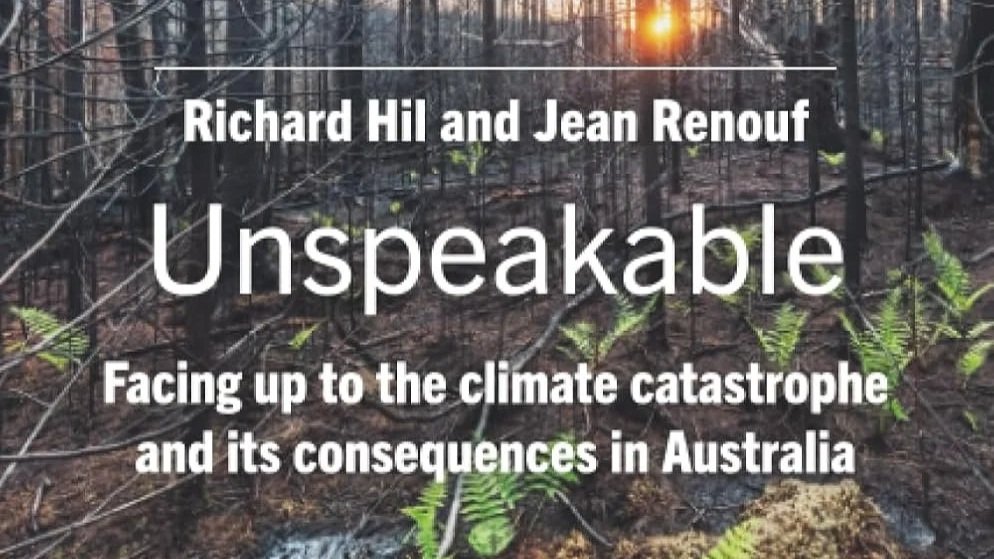
(Picture from the Unspeakable book cover)
The psychological shock of all this was immediate and profound – compounded by a second major flood only weeks later. Some residents lost their homes and/or livelihoods in the space of a single night; others lost neighbours, friends, or the landscapes that defined their sense of place. Yet even those untouched physically carried the imprint of the event – a collective jolt that rippled across the region. No one was spared the grief or disorientation that followed. The scale of loss, and the speed of it, unsettled our sense of safety and permanence in ways that continue to linger.
And yet, in the absence of functioning institutions, something extraordinary happened. In dozens of isolated pockets across the Northern Rivers, communities mobilised spontaneously. People who had never spoken to each other before, climbed into tinnies and kayaks, launched private boats, flew helicopters to evacuate people or drop goods, used tractors and machinery to reopen rural roads, improvised rope bridges, and went street by street to pull people from rooftops and out of attics. Rescue efforts unfolded from verandas, school ovals, community halls, car parks, makeshift helipads – anywhere dry ground could be found.
As the floodwater slowly receded, the response only grew. Donations poured in from across the region and beyond. Spontaneous community hubs formed, with people organising food distribution, cleaning crews, welfare checks, emergency accommodation, animal rescues, medication runs, and the clearing of unimaginable volumes of debris and mud. These hubs meshed with neighbourhood centres, community halls, and local councils, creating a decentralised yet remarkably coordinated response that carried many communities through the early months.
The trauma was deep and remains so. But the community response – its speed, its organisation, its sheer determination – was nothing less than astonishing.
Both authors of this book were involved in these efforts: as residents, as neighbours, as a firefighter, as people who led when needed and followed when someone else knew better. The experience was shattering, illuminating, and transformative. It revealed not only the fragility of the systems we rely on, but also the depth of collective care that remains possible, even amid devastation.
Our own response was shaped in part by prior experience. One of us, Jean Renouf, had previously worked internationally in disaster and conflict zones, and in 2019 founded Plan C (‘our plan is the community’), a not-for-profit dedicated to strengthening community resilience, precisely because we anticipated that large-scale, cascading disasters – climatic, social, economic – would arrive in our region before our institutions were ready. We were acutely aware of the climate science, systemic risk, institutional fragility, and the urgent need to strengthen community resilience.
And still: the shock of 2022 got deep into our bones.
Despite our awareness, training, and experience, nothing buffered us from the trauma that followed – the exhaustion, the burnout, the grief for what was lost and what might still be lost. We witnessed firsthand the trauma etched on the faces of friends and acquaintances whose homes were caked in toxic mud, or who attended a free counselling service soon after the tragedy. We saw the tears, the anguish, the bewilderment, and shock – feelings viscerally familiar to us. We felt what thousands of others felt: the disorientation of realising that the systems meant to protect us could be washed away overnight. The realisation that – ‘this is it’, this is climate disruption in full view – a scenario of disaster that will reoccur many times, in worse ways, for the rest of our lives.
But we also witnessed something else: a communal spirit emerging from the chaos, a clearer picture of what must be done, what is possible, and what communities can build when they no longer have the luxury of waiting.”
Use this discount code for a 30% - limited in time: UNS30
That is how Unspeakable begins
Richard Hil and I chose to open there, on the morning our region changed, because it holds in one place the two things we have spent years trying to understand. The first is how quickly the systems we take for granted can give way. The second is what rises in their place when they do.
Some realities are hard to say out loud, but they are often the ones we most need to. Chief among them, for Richard and me, is that climate catastrophe has already arrived, that the institutions we were told would manage it were never built for the scale or the speed at which it is now moving, and that across much of Australia, in the places shaped by fire and flood and drought and heat, what many still describe as coming has in part already come.
We wrote Unspeakable because we wanted to stay with that reality longer than public conversation usually allows. The climate catastrophe, alongside the multiplicity of global challenges such as biodiversity loss, political fragmentation, geopolitical risks, artificial intelligence etc., is the story that will accompany us for the rest of our lives, less an event than a condition, one that keeps reshaping how we live, how our communities hold together, how governments respond, and what we understand our responsibilities to one another and to Country to be. A Great Unravelling. That is hard to fathom, and harder still to face.
Much of the public conversation still moves between two settings that both fall short. There is reassurance, the sense that technology or policy will in time bring the matter back under control, a false hope. And there is despair, the sense that because the disruption is so large, nothing worth doing remains. Powerlessness. Neither has seemed to us adequate to where we actually are.
The argument the book makes is not complicated, though what follows from it is. The climate catastrophe is no longer arriving; it is already here, and its consequences in Australia will ask more of us than our institutions, arranged as they currently are, seem ready to give. Facing that does not mean giving up on anything. It means beginning from where we actually stand, rather than from where we would prefer to.
What the book is about
Unspeakable is about the things many of us register but struggle to name, the silence that surrounds climate catastrophe even as its effects grow more visible, and the feeling so many people carry that the reassurances on offer do not quite match what they can see out their own windows.
It confronts the silence around these facts. Drawing on interdisciplinary scholarship and grounded case studies from Australia, the book portrays climate disruption not only as a scientific or technical problem, but as a crisis of meaning, relationship, and moral responsibility. It explores grief, power, and inequality alongside practices of mitigation, adaptation, resilience, and regeneration, with particular attention to how communities respond when institutions falter.
Underneath all of it sits a practical and human question, which is what it might mean to live well as the world as we know it unravels before our eyes.
Why we wrote it
We wrote Unspeakable because climate change has become at once everywhere and strangely difficult to say. It shows up in the weather and the insurance premiums, in the exhaustion of emergency workers and the grief of communities rebuilding after a disaster, in the calculations families make about where it is still safe to live. And yet we go on speaking, much of the time, as though the basic arrangements of life will hold, provided we make a few sensible adjustments, which is becoming harder to credit.
Life continues, of course. People raise children and run businesses and plant gardens and show up for their neighbours. What is less settled is the kind of life that becomes possible once the systems around us are less stable than we were taught to expect, and that is the question the book turns toward. Facing the Great Unravelling squarely does not take agency away. On the contrary, it gives some back, since it lets us stop waiting for permission. It allows us to begin asking more useful questions about preparedness and community and care and where power actually sits.
Who it is for
Unspeakable is written for people who are already uneasy, who sense that something is coming apart even when they do not have the language for it, and who would rather understand what they are living through than be reassured out of it. It is for people in councils and community organisations, in businesses, universities and emergency services and the informal networks of care that hold a place together, who know they will be asked to keep things standing when the systems around them come under load. And it is for anyone trying to make sense of it all without going numb.
The book does not offer false comfort, and it does not pretend the scale of climate disruption can be shrunk to a matter of personal development, or solved by individual lifestyle change alone. What it does hold onto is that meaningful action remains available, and that it comes through emotional, social and practical work.
So the book ranges widely. It sets the science, and what it means for the Australia our children will inherit, beside the harder human questions the science tends to leave out, the grief it stirs and the unequal weight of who is sheltered and who is exposed. Much of it attends to what communities themselves have done, here in the Northern Rivers and in other places, when the institutions above them gave way. Its second half turns practical, toward what a person, or the street they live on, might begin now, without waiting for government or a workplace to move first.
The book is our attempt to stop looking away, and to see what becomes possible once we do.
***
Unspeakable: Facing up to the climate catastrophe and its consequences in Australia is out now with Peter Lang. Find more about it here.
Use this discount code for a 30% - limited in time: UNS30