How bad could it get? Australia's converging crisis risks in 2026
In brief: The stressors converging on Australia right now — a threatened Strait of Hormuz, spiking fertiliser costs, AI, El Niño, financial fragility — are not arriving in sequence. They are arriving together, each reducing the margin available to absorb the others. This piece asks the question most analysis sidesteps: given what is already in motion, how bad could it actually get?
Imagine it is October 2026 and the world is in a worse place than it currently is: the Iran ceasefire that held through April has fractured; a second round of strikes has closed the Strait of Hormuz again just as El Niño begins delivering its worst drought conditions in two decades across South and Southeast Asia; urea prices that had already doubled since February have doubled again, leading to agriculture disruptions and food shortages (urea is the synthetic fertiliser that most of the world's staple crops depend on). In Australia, the gaps on supermarket shelves that most people had only ever seen in footage from somewhere else start appearing in capital cities. The federal government announces emergency import arrangements.
This is one version of the next twelve months. Not a prediction. A possibility assembled from conditions already in motion, which is a different and more troubling thing.
On 1 April, Prime Minister Albanese delivered a rare national address — the kind previously reserved for the Global Financial Crisis and COVID — telling Australians that the months ahead "may not be easy" and urging them to conserve fuel. It was measured, carefully worded. In its restraint, it was more alarming than most people seemed to register.
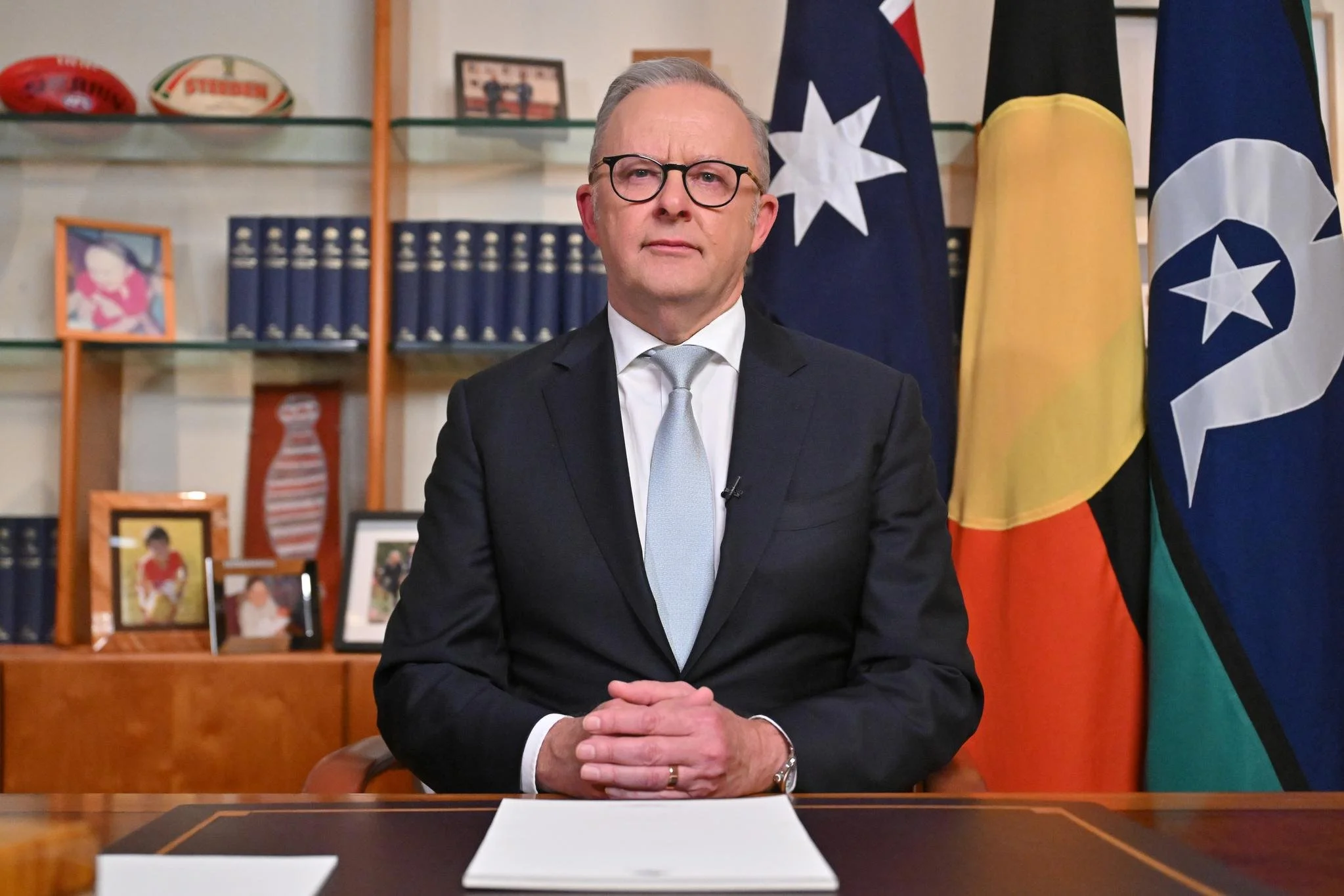
(Picture by Mick Tsikas/AAPIMAGE)
The question his address carefully did not answer is the one this piece wants to sit with: how bad could it actually get in the coming 12 months?
The answer depends on two variables that are often collapsed into one: the severity of the shocks themselves, and the condition of the systems asked to absorb them. A given disruption can remain manageable in one context and become cascading failure in another. The difference lies in resilience — in margins, buffers, redundancy, trust, and the capacity to adapt under pressure.
The stressors are real, and they are converging
Roughly a fifth of global oil supply moves through the Strait of Hormuz. Any prolonged disruption there is not only an energy problem. Modern agriculture depends on synthetic fertiliser, and synthetic fertiliser depends heavily on natural gas. When gas flows tighten and fertiliser prices spike, the problem moves upstream of supermarket shelves and into planting decisions, crop yields and future food prices. Add the possibility of a strong El Niño driving drought across grain-producing regions and lifting the price of rice, sugar and food oils, and the issue is no longer a single shock. It is multiple shocks landing on the same system at once.
Yet the food system was already fragile. It has been optimised for efficiency rather than resilience: just-in-time logistics, concentrated processing, dependence on a narrow range of suppliers and inputs. Those arrangements make food cheaper in stable conditions. Under stress, they become channels through which disruption spreads.
None of these stressors are running in sequence. They are running simultaneously, each reducing the margin available to absorb the others.
The brittleness underneath
Whether those stressors produce manageable disruption or something more serious depends entirely on what they land on. And the systems they are landing on are, in several important respects, more fragile than they appear.
Financial systems are carrying sovereign debt loads that leave many governments with less room to respond than they had in previous crises. The familiar shock absorbers — fiscal stimulus, cheap money, coordinated international action — are less available than they once were. Meanwhile, the multilateral architecture that historically helped turn crises into managed disruptions — the UN, IMF, WTO, World Bank etc — is operating on a weaker political substrate. Strategic rivalry, sanctions, trade fragmentation and declining trust have all eroded the machinery of collective response. If the next serious crisis requires coordination, it will arrive at a moment when the table around which that coordination would happen is more fractured than at any point in decades.
There is also a quieter erosion beneath the visible one. Anxiety around economic insecurity and AI-driven job disruption is already weakening confidence inside organisations and households. That does not need to produce mass unemployment to matter, but only to create enough unaddressed anxiety at the workplace level to erode the trust and civic participation that resilient societies draw on during crises. Forty percent of workers globally now report concern about AI-driven job loss. Sixty-two percent say their leaders are underestimating the psychological impact. This is a real-time erosion of institutional trust happening in workplaces everywhere, quietly, underneath the larger disruptions.
Then there is the brittleness hardest to quantify and most consequential: the erosion of the shared systems that allow people to respond collectively at all. The 2026 Edelman Trust Barometer found that people globally no longer share the same information sources, authorities, or even the basic validity of disagreement itself. The Global Peace Index reports that indicators of social fragility are at their highest levels since the end of World War II — and the mechanisms societies normally use to absorb shocks are operating on a weaker substrate than at any point in recent memory. In Australia, only 33 per cent of adults believe the federal government can be trusted to do the right thing by the Australian people all or most of the time, down from 44 per cent in 2021. This is worth noting because societies do not absorb crises through infrastructure alone. They absorb them through trust, through participation, through the everyday belief that collective life is still broadly workable. When that belief has already begun to fray, larger disruptions hit harder.
There is a compounding factor that material analysis tends to undercount: the capacity to make good decisions deteriorates precisely when good decisions matter most. Under sustained pressure, the information environment degrades alongside everything else — misinformation spreads more easily, authoritative sources are trusted less, and the shared factual ground that collective response depends on becomes contested. In disaster and conflict settings, the collapse of reliable information is itself one of the primary amplifiers of harm, turning manageable disruption into cascading failure by preventing the coordinated responses that would otherwise slow it (I’ve explored how to navigate uncertainty and misinformation in another piece).
In Australia, this brittleness is not abstract. In April 2025, before the current conflict began, thirty-five percent of Australian adults already described it as difficult or very difficult to get by on their current income — the highest figure since 2012. One in seven Australians — 3.7 million people — are currently living below the poverty line. One in four low-income renters is spending more than half their income on rent. One in three households is already experiencing food insecurity: the Foodbank Hunger Report 2025 found 3.5 million households regularly facing the question of what, if anything, goes on the table at the next meal, with sixty-one percent of those severely affected — compromising on nutrition, skipping meals, or going entire days without eating. Forty-one percent of Aboriginal and Torres Strait Islander households report food insecurity. Australia may produce more food than it consumes, but that does not make households immune to disruptions in fertiliser, freight, packaging, fuel, pricing and distribution.
The brittleness of Australian business is no less real. Over 7,400 companies entered external administration by the end of 2024, a 47 per cent increase on the previous year. Projections suggest up to 14,000 companies could enter external administration in the current financial year — the highest since records began. These are not marginal or poorly run enterprises disappearing from the fringes. Small and medium businesses account for the overwhelming majority of insolvencies, with 83 per cent holding assets of $100,000 or less and 82 per cent employing fewer than 20 staff — the businesses that form the connective tissue of local economies, employ neighbours, and anchor regional communities. Beneath the insolvency figures sits a wider fragility: nearly 80 per cent of Australian small and medium businesses reported cash flow impacts over the past year, and between 15 and 27 per cent hold minimal or no cash buffer at all, well short of the three to six months of operating expenses that financial advisers consider a basic threshold of resilience. A business carrying no buffer does not need a severe shock to fail. It needs one more thing to move against it — a delayed payment, a cost increase, a week of lost revenue — at a moment when it has nothing left to absorb it with.
This is what stress looks like before a major external shock arrives. A system carrying this much pre-existing strain does not need an extreme trigger to tip into serious difficulty — it needs only a moderately bad shock arriving at the wrong moment, into a population with depleted capacity to absorb it.
The confluence of risks
The first danger in such a moment is disorientation.
Modern societies depend on a background promise that essentials will remain available and that authorities broadly understand the scale of the problem. Once that promise begins to wobble, behaviour changes quickly. Households buy more than they need. Businesses protect stock. Farmers delay decisions. Freight operators become selective about which routes and cargo they will take on. Governments reach for emergency powers while trying to avoid the language of emergency. Trust, once unsettled, becomes part of the supply-chain problem.
The danger is a confluence of pressures that prevents the usual recovery mechanisms from activating. The scenario becomes less cinematic than cumulative. Every system you reach for to stabilise one problem is already under strain from something else. A medium-sized logistics or construction business with margins already compressed by energy costs, delayed supplies and insurance increases does not need a spectacular crisis to fail. Multiply that across the hundreds of thousands of small and medium businesses that form the connective tissue of the Australian economy, and the fragility becomes visible at scale.
Australia often speaks as though distance protects us. In some respects, it does. In others, it magnifies dependence. We remain tied to global flows of fuel, fertiliser, chemicals, finance, medicines, shipping and public trust. Wealth does not exempt a country from material constraints. It changes how those constraints arrive and who absorbs them first.
And they would not be absorbed evenly. Those with savings, storage space, secure housing, flexible work and strong local ties would cope very differently from those already living week to week. The first impacts would be felt hardest by people spending most of their income on food, rent, transport and energy; by people with chronic illness or disability; by carers; by regional communities; by Aboriginal and Torres Strait Islander households already facing higher food insecurity; and by those for whom one interrupted week is enough to destabilise an entire month. Scarcity is never only about goods. It is about unequal exposure.
So how worried should we be?
More than the dominant social mood currently reflects.
The honest answer is still that we do not know how bad it will get. That uncertainty is real, and it is part of the problem. The conditions that would produce serious but manageable disruption and the conditions that would produce something more severe are not yet clearly distinguishable from where we stand. What can be said is that the stressors are concurrent, the brittleness is real, the buffers are thinner than most people assume, and the systems meant to cushion shocks are weaker than they appear.
What makes compounding disruption genuinely different from a single severe shock is not only how systems fail but how — and whether — they recover. Systems that degrade together do not recover together, and the sequence of recovery matters as much as the original disruption did. Some businesses that close during a compounding event would have survived a single pressure with room to spare; they do not reopen when conditions improve. Some households that exhaust their reserves and social capital during a prolonged squeeze do not rebuild them on the same timeline as the economy. Preparing for compounding pressure is not preparing to endure a difficult period and return to what came before. It may be preparing for a new baseline.
That does not justify panic, but it does rule out passivity.
The most protective response — at every level — is to build genuine resilience before it is needed: financial reserves where possible, redundancy in critical dependencies, and above all the social infrastructure that evidence consistently shows matters most when systems fail. Knowing your neighbours well enough to ask for help and to offer it. Having honest conversations with family, friends and colleagues about what you would each do if things became significantly harder. Belonging to networks — a street, a faith community, a sporting club, a local resilience group — where reciprocal support is already normal rather than something that has to be invented under pressure.
People who face acute uncertainty inside a web of relationships they trust fare measurably better — in health outcomes, in decision quality, in the capacity to keep functioning — than those facing the same conditions in isolation. The social fabric is not soft infrastructure. In a period of converging disruptions, it is the infrastructure that holds everything else up.
Because the deepest challenge here is cultural. Can we learn to discuss deterioration without denial and without melodrama? Can we admit that advanced societies are not immune to shortages, only less accustomed to them? Can we stop treating fragility as somebody else's story?
How bad could it get? Bad enough that many Australians would experience, perhaps for the first time, a loss of confidence in the everyday systems that organise life. Bad enough that inequality would sharpen quickly into visible harm. Bad enough that communities with strong local ties would cope far better than those without them.
That still falls short of total collapse. Reality is usually less cinematic and more uneven than that. Systems stagger, improvise, partially recover, then degrade again. Some institutions fail. Others surprise us. People behave selfishly and generously, often in the same week. A country can remain recognisably itself while becoming harsher, more brittle and less governable. Perhaps that is the more realistic concern: not one spectacular disaster, but a cumulative thinning of reliability — fewer buffers, higher costs, longer delays, rougher politics, more frequent emergencies, and more households living close to the edge.
A society can absorb a great deal of damage before it names what is happening. It can live for years in a state of managed unravelling.
The useful question is no longer whether such a future is possible, but whether we will keep waiting for certainty before preparing for what is already plausible.