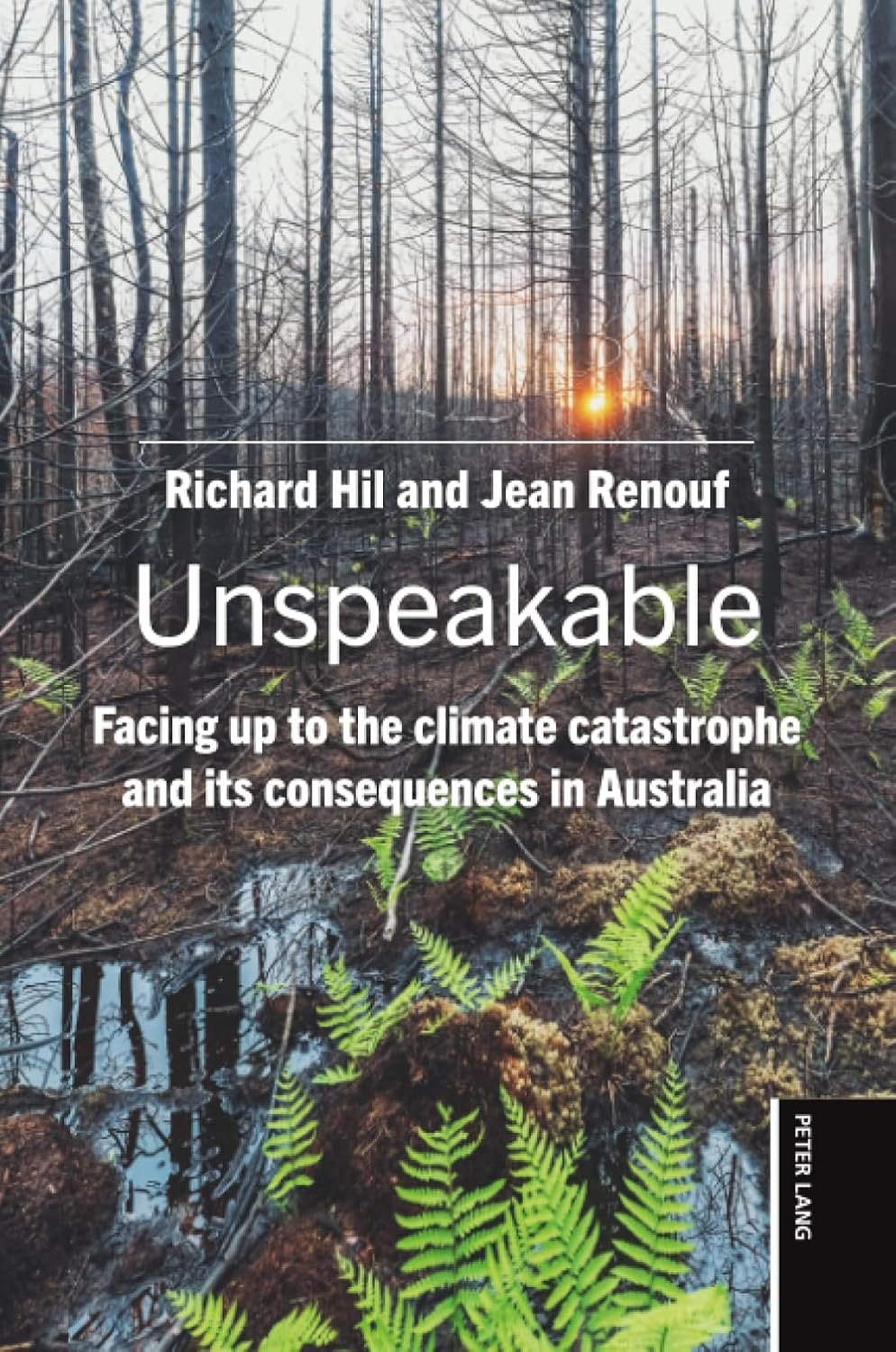
New book urges Australians to face the climate catastrophe already here, and to act without waiting for government
Unspeakable, by Dr Jean Renouf and Professor Richard Hil, draws on decades in disaster zones and the 2022 Northern Rivers floods to chart a way through climate disruption.
Published by Peter Lang, out now.
NORTHERN RIVERS, NSW — A new book by resilience practitioner Dr Jean Renouf and sociologist Professor Richard Hil argues that Australia's climate future is no longer a matter of forecasts, that its consequences are already reshaping communities, and that the response capable of meeting it is emerging from those communities rather than from the institutions above them.
Unspeakable: Facing up to the climate catastrophe and its consequences in Australia (Peter Lang, 2026) confronts what the authors call the silence around climate collapse: the difficulty of saying plainly that the crisis is a present condition, that trusted institutions are already failing to hold the line, and that in parts of Australia swept by floods, fires, droughts and heatwaves, what is coming has in part arrived.
Rather than treating climate disruption only as a scientific or technical problem, the book approaches it as a crisis of meaning, relationship and moral responsibility, setting grief and inequality alongside the practical work of mitigation, adaptation, resilience and regeneration. Its particular focus is how communities respond when institutions falter, and how civic life and collective agency emerge amid systemic disruption.
The book opens with the catastrophic 2022 floods in the Northern Rivers, where both authors live and work, and draws on the authors' direct involvement in the community response. Renouf spent fifteen years in war and disaster zones internationally before founding the community resilience registered charity Plan C in 2019, ahead of the Black Summer fires and the floods that followed, and the resilience consulting firm Safer Future. He serves as a firefighter with Fire and Rescue NSW and has earnt medals and citations for his work.
“The hardest thing about the climate catastrophe is often to say, in an ordinary voice, that it is already here,” said Dr Renouf. “Richard and I wrote Unspeakable to be honest with that difficulty, and to show that once a community can face what is happening, it usually turns out to have more agency than it believed. The book offers people concrete things they can do now, in their own lives, without waiting for permission.”
The book carries advance praise from across science, emergency management and community leadership. Former Fire and Rescue NSW Commissioner Greg Mullins AO writes that “while speaking honestly about what we all face, it provides hope rather than despair and throws us a lifeline,” calling Unspeakable “a must read.” Clive Hamilton, Professor of Public Ethics, describes it as “a field guide to life at the end of the world as we know it.” Mel Bloor, a community leader states, “this book has both fanned my activist flame and reminded me of the deep still pool that I can be for both myself and my community.” Ian Dunlop, formerly Chair of the Australian Coal Association, and CEO of the Australian Institute of Company Directors, “thoroughly recommends” it. Ian Lowe AO, an Emeritus Professor of Science, Technology and Society, said “It will help you be part of the change we all need.”
Book details
Title: Unspeakable: Facing up to the climate catastrophe and its consequences in Australia
Authors: Richard Hil and Jean Renouf
Publisher: Peter Lang (Science, Society & Culture)
Published: July 2026 · 218 pp · English · Softcover and eBook (PDF, ePUB)
ISBN (softcover): 978-1-80374-544-2
Price: US$52.95
Publisher page: peterlang.com/document/1461391
More: jeanrenouf.com/unspeakable
Interviews
Dr Jean Renouf and Professor Richard Hil are available for interview, in person or remotely. The authors can speak to disasters across Australia, community-led disaster response, the gap between emergency plans and readiness, the psychology of facing climate disruption without turning away, and what anyone can do to live better in times of crisis.
Media contact
Jean Renouf, jean@safer-future.com, 0427 774 415
About the authors
Dr Jean Renouf spent fifteen years in war and disaster zones before founding the community resilience registered charity Plan C in 2019. He works with leaders and organisations on crisis-ready capability through his consultancy Safer Future, serves as a firefighter with Fire and Rescue NSW, and holds a PhD from the London School of Economics.
Professor Richard Hil is an Australian sociologist and writer whose work focuses on power, inequality, youth, social change, and contemporary cultural critique. He is also an Adjunct Professor in the School of Health Sciences and Social Work at Griffith University, Gold Coast, and Adjunct Professor in the Faculty of Law, Business and Arts at Southern Cross University.
ENDS
Notes to editors: Cover images and author headshots are available upon request. Review copies are available through reviews@peterlang.com.